January 30, 2007

Myth Busting

Here are a few excerpts from Chapter Two (PDF) of The Outrage of Project Follow Through: 5 Million Failed Kids Later. There are a few more excerpts that deserve a post of their own. Hopefully I'll get to them.

On Parental Support

Increased parental support is frequently trotted out as a cure for our education woes. My position has been "great if you can get it, but in all likelihood, you won't get it for the kids most in need of it." Here is Engelmann (p. 14):

One Piagetian-based approach was that of Ira Gordon from the University of Florida. His idea was to provide stimulation in school and use trainers to visit parents and instruct them in how to work with their children at home on the same Piagetian activities that were presented in school. I thought he was either misguided or the kids in Florida were a lot different from the ones we worked with in Urbana, California, Chicago, and Pennsylvania. Gordon’s strategy might have worked with the kids in Toronto [i.e., strong concerned parents], but not with kids who need more help. With the inner-city population, there is little likelihood of either being able to work extensively with the parents or of the parents working successfully with their kids. This is not to say Gordon's goals were ignoble, simply impractical. If it’s not taught thoroughly in school, the parents of the kids most in need are not going to be successful at augmenting the program.

Engelmann's identified two problems with trying to get increased parental support: 1. you can't get it from the parents who would most benefit from it, 2. even if you can get it, the parents will likely be capable of providing the needed instructional support, 3. even if they can, success still depends on how well the material is taught in school in the first place. And, there we are right back where we started, poor instruction in school clogging up the works. Remember, if the instruction in school were better, schools wouldn't be looking for parental support in the first place.


On Why Kozol is an Idiot

Kozol and his ilk believe that the achievement gap of poor blacks is the result of a social problem that is rooted in history and caused by discrimination against blacks. Their solution is to negate the social problem by putting poor kids into more affluent schools. This solution is based on Thomas Pettigrew's analysis of the Coleman Report data which found that "black students attending mostly white schools had achievement levels much higher than blacks in segregated schools. Also, in these schools, the white students’ performance was no worse than that of whites in segregated schools." This conclusion begot bussing. Bussing failed miserably. Engelmann explains why (p. 7)

The conclusion drawn by a thoughtful person who was not racially prejudiced would probably have been, “So what? Just as there are middleclass whites, there are middle-class blacks. Middle-class kids perform at a high level whether their neighborhood schools are segregated or integrated.”

Once more, policy makers confused correlation with causation and drew the conclusion that if black children in integrated schools performed higher, putting black children into white schools would create an integrated school, and the children in this integrated school would perform as well as the children in schools that were “naturally” integrated.

This reasoning is both romantic and cruel. Jackie and Alan couldn’t perform on fourth-grade instructional material in any school. They had learned only about two years worth of skills in four years. Putting them in a fourth-grade classroom with children who performed two years above them would constitute incredible punishment, not intelligent education that ostensibly addresses “the local needs of the children.”

Yet the meme not only persists today, it remains very popular, as do all non-educational solutions to what is in essence an instructional problem.

On the Failure of John Dewey

(p. 21)

I found the naiveté of proponents of progressive education shocking. If people knew much about John Dewey, they would have known that he and his wife operated two lab schools based on radical progressive education and both were unquestioned failures. The first was at the University of Chicago. It failed so categorically within three years that Dewey was forced to leave Chicago. He went to NYC where he and his wife founded his famous Lincoln School in Manhattan. This effort failed in two years. Yet, a hall full of grown, educated people from NYC found the slogan, “learn by doing,” something of both a battle cry and religious experience, regardless of the amount of student failure it generated.

On why you want it teach it correctly the first time

The reason why you want to teach it right the first time is because if you teach it wrong it becomes much harder to correct. (p. 46):

Our compulsion to obtain current data on the performance of every student stemmed from some facts about learning and relearning. The relationship is simple: The longer a student has misunderstood something, the longer it takes to teach the content correctly. If the teacher uses a good reading program, at-risk beginning readers will learn to discriminate the words a and the with perfect accuracy after about 40 trials. If the teacher uses a poor program and children confuse a and the, their confusion becomes solidly ingrained. When they are fourth graders, it takes about 400 trials to re-teach them so they are perfectly accurate at reading these words. If the remedy is delayed until the students are in high school, it will probably take more than 1,000 trials to induce the correct behavior.

I think it's safe to say that most teachers don't go over anything approaching forty times in the first place. And 1000 times in high school to correct something taught back in first grade? No wonder why high school teachers think it's hopeless to remediate. It is.

On cognitive ability and instructional pacing.

Charles Murray created quite the stir two weeks ago but his underlying premise is accurate--high IQ kids can learn considerably faster than low IQ kids even when the instruction is exemplary (p. 46):

Our initial plans for securing data involved both record keeping and frequent observations of teachers. We first set minimum expectations for every instructional group. Highest groups were expected to progress the fastest through the program—about 1.5 lessons a school day. The expectation for average groups was about 1 lesson a day, for low groups about 3/4-lesson per day. These projections were to be modified as we discovered more about the performance level of each child.

The high performing groups are capable of learning at twice the pace of the low performing group. (Engelmann has said elsewhere that he believes that the high performers can proceed at three to four times the lowest rate.) Today, the lowest group gets extra instructional time to make up for their slower pace.

January 29, 2007

Standards, Standards, Everywhere

Brett of Dehavilland Blog has a good post up on academic standards and why moving them from the state to the federal level isn't going to get us where we want. Brett points out that the problem isn't where the standards are enacted, but rather the contents of the standards themselves.

I'd call this the E.D. Hirsh fallacy. Just because the student should know x by grade y, doesn't mean that it's possible to teach him all of x or that he necessarily needs to know all of x in the first place.

Chapter 2 Now Up

Chapter Two (PDF) of Zig's New book has just been posted.

The primary enemy that educators had to fight then and now is evaluation, because evaluation reveals the discrepancies between the educational rhetoric and the effectiveness of the schemes based on this rhetoric.

Which is why NCLB has met with such resistance.

On bussing and the Coleman Report:

Like hermit crabs who have lost their borrowed shell, educational policy makers were denuded by the Coleman Report, and like hermit crabs, scurried to find security, regardless of how bizarre the shelter was. Their effort resulted in one of the more inhumane programs ever initiated—bussing. For educators, however, bussing was an ideal solution, because herding children into a bus did not require any kind of instructional expertise.

Because bussing was a non-instructional remedy to an instructional problem (the failure of the schools to teach children effectively), policy makers needed some compelling rhetoric to make busses symbols of progress. They fixed on history and redefined the performance problems of poverty blacks as a social problem, rooted in history and caused by discrimination against blacks. With this link established, policy makers could point to busses and declare, “There's your evidence that we are responding to the data. We are breaking down discrimination. Therefore,
we are addressing the fundamental causes of the poverty blacks’ performance problems.”

On social promotion as the inevitable result of bussing/affirmative action:

“We’re supposed to have standards here. We don’t do social promotions. So if I place black kids where they belong, more than 75 percent of them would be in special ed. If I put them in special ed, I’m a racist. If I leave them in the regular classrooms and flunk them, I’m either a racist or an ogre who doesn’t understand affirmative action. So what do I do, close my eyes, sell out our standards and socially promote them, or go to another school?”


On the origins of Constructivism:

One of the [program sponsors in Project Follow Through] was Lauren Resnick, then a behaviorist at the University of Pittsburgh, who wanted to use her site to develop an
approach to teaching classification, which she seemed to think was the end-all of instruction and would permit children to do remarkable things. We had talked with her before the meeting. Wes thought she was great. I thought she was quite smart but lacked sensitivity to the problem of providing a service for these children. She seemed far more interested in her model for teaching classification (which was neither analytically nor practically very sound) than she was in considering Follow Through children as more than subjects in her experiment. She would later become a non-behaviorist, the flag bearer of a failed approach called constructivism.


On John Dewey:

A distinguished white-haired man on the main floor stood up and gave a long, dramatic oration. He ended by saying in rising volume, “I hear talk of skills and sub-skills and sub-skills of sub-skills, but why is there nowhere in Mr. Engelmann’s presentation one word about [pause and dramatic point toward the ceiling] learn by doing and do by doing!”

Explosion of cheers, shouts, applause, which lasted probably more than 10 seconds.

When the place calmed down, I said, “Well, I promised Bob Egbert that I wouldn’t say bullshit, but I’ll try to answer your question anyhow.” I went on to explain that not only was the originator of slogans about learning, John Dewey, dead but that there was nothing to suggest that his slogans had much relevance to the problems facing disadvantaged kids. As I talked, the man’s face became so red I thought he would explode. After the meeting, Bob Egbert looked at me with a wry smile and shook his head. I later found out that the man with the long question was the director of math instruction in NYC.

January 26, 2007

On Improving the Traditional Curriculum

(Cross posted at KTM-II)


Here's a question I've been struggling with for some time now:

Under the traditional curriculum why didn't mastery learning become the norm?

With the exception of the haphazard presentation of material is some of today's constructivist texts, traditional texts typically present a lesson, provide some practice, and then move on to the next topic in the sequence. Many students learned the material using this approach, but there was no effort to get the student to master the material and firmly place the material into the student's long term memory where it is somewhat protected against the ravages of forgetfulness. The inevitable result is that the student partially or fully forgets much of the material once the class moves on, unless the skills taught are used in subsequent lessons (like in elementary math). It was rare that we ever got a cumulative exam at the end of the year which was probably intentional because most of the students had forgotten the material taught in the first half of the year. This practice was mitigated to an extent by the fact that much of the material was retaught year after year--a precursor to today's spiral curriculum.

Nonetheless, this seems to be a horribly inefficient way of teaching to me. Yet it seems the have developed as the dominant form of (pre-constructivist) instruction by the latter half of the 20th century.

The question is why did it develop this way? Why not mastery learning?

Before you answer take a look at this blurb from Engelman's new book (pp. 30-31):

Mastery is essential for lower performers. Unless the practice children receive occurs over several lessons, lower performers will not retain information the way children from affluent backgrounds do. Prevailing misconceptions were (and are) that children benefit from instruction that exposes them to ideas without assuring that children actually learn what is being taught. If you present something new to advantaged children and they respond correctly on about 80 percent of the tasks or questions you present, their performance will almost always be above 80 percent at the beginning of the next session. In contrast, if you bring lower performers to an 80 percent level of mastery, they will almost always perform lower than 80 percent at the beginning of the next session.

The reason for this difference is that higher performers are able to remember what you told them and showed them. The material is less familiar to the lower performers, which means they can’t retain the details with the fidelity needed to successfully rehearse it. After at-risk children have had a lot of practice with the learning game, they become far more facile at remembering the details of what you showed them. When they reach this stage, they no longer need to be brought to such a rigid criterion of mastery. At first, however, their learning will be greatly retarded if they are not taught to a high level of mastery.

This trend was obvious in the teaching of formal operations. At first, the low- and high-performing groups were close in learning rate. Later, there were huge differences. Group 2 was able to learn at a much higher rate, largely because it was not necessary to bring them to a high level of mastery. On several occasions, I purposely taught the children in Group 2 to a low level of mastery (around 60 percent). I closed the work on the topic with one model of doing it the right way, and I assured the children that this was very difficult material. At the beginning of the next lesson, almost all of them had perfect mastery.

So, I think the answer to my question as to why mastery learning didn't become the norm is simply that it wasn't needed. Why go through all the effort of mastery learning when the higher-performers really didn't need it to learn? If the teacher is basing their performance on the feedback they are receiving from the successful students (only 60% mastery is needed), it's easy to see how one could reach the false conclusion that that's all the teaching a student needs to learn. And human nature being what it is, why teach more when less will do.

Nonetheless, I think we now know enough about how the brain works to know that retention of learned material is greatly enhanced when the learner engages in distributed practice after the initial mass practice. All students would benefit from distributed practice. So why haven't traditional educators changed their ways to offer more distributed practice?

I understand there is a philosophical objection to distributed practice (i.e., drill and kill)at the elementary school level. But what about at the secondary and post-secondary level where traditional education is still the norm? At this level, distributed practice just means giving a a couple of additional independent work problems that keeps previously taught material alive for the student until the material is better retained in long term memory. So why are classes at these levels still taught like the need for distributed practice doesn't exist?

Moreover, if the goal is to eradicate the worst practices of constructivist teaching, wouldn't it be beneficial to improve traditional teaching methods to incorporate techniques that will improve student performance? One of the reasons why constructivism has gained the foothold it has is due to the underperformance of the traditional curriculum, especially among lower-performers.

Discuss.

January 24, 2007

Empty Rhetoric

The Bereiter-Engelmann Preschool opened in the mid 1960s. There they honed many of the techniques that later found their way into Direct Instruction.

Despite the academic success of the students, the preschool was highly controversial and despised by educators of the day. It might as well have been yesterday, because the views remain the same.

Near the end of the first year, a group of child developmentalists from New York City visited the project and expressed strong disagreement with our practices. After they observed the groups being taught, one of them gave a speech on how a teacher must get on the same level as the child and share the child’s feelings and goals. She concluded by saying that we had no regard for children’s inner feelings.

Such opinions continue to be the prevailing wisdom today. It was empty rhetoric then and it's empty rhetoric today.

I told her that if she was so knowledgeable about children’s feelings, she should have no trouble identifying which of the seven children in the math group she just observed witnessed his father being shot to death on the preceding evening. Of course she couldn’t do it because all the children in the group responded with alacrity, laughed, and won all the challenges I said they couldn’t possibly win.

It doesn't get much worse than that does it? Witnessing a parent being shot and killed. Seems to be on par with the typical excuses we hear from educators excusing their lack of performance: toothaches, hunger, bad home life, poverty, etc., etc.

And yet, the child was able to do his schoolwork that day just like the other kids. His performance did not have to be excused. He was being effectively taught. And that makes all the difference in the world.

I explained that we understood how that boy must feel, and we expressed our sorrow. But then we provided the boy with relief from his anguish by putting him in a familiar routine that took his mind off his grief and gave him an opportunity to do something energetic and consuming. Rather than thinking about the horror of the preceding night, he thought about math.

Because in the end what matter most is that these children get a proper education despite the obstacles they face. I'm sure little Johnny would rather have a decent education at the end of the day rather than a litany of excuse he could recite explaining why I didn't get one. Well, son, you can't read, write, or do arithmetic very well, but that's not you're fault, you never developed properly due to your learning disability, poverty, and bad home life. The world awaits you, get to it.

Carnival of Education

The 103rd Carnival of Education is up at The Education Wonks. Lots of good stuff. Go check it out.

January 23, 2007

Chapter One

Engelmann has posted the first chapter of his yet to be published book The Outrage of Project Follow Through: 5 Million Failed Kids Later. The chapter will only be available for two weeks, so go get it now while it's still free.

It is a rare opportunity to be able to read anything from a educator who has successfully educated. Mostly we get opinions from those who have never educated anyone except those kids at the top of the distribution who seem to learn no matter how they are taught. What you mostly get from these sources is bad conclusions drawn from faulty premises.

For example, most educational programs and curricula are poorly designed. Teacher designed curricula are some of the worst offenders in this regard because teachers are novices when it comes to curricular design. They will unwittingly reveal this when they say things like the frequent canard that "not all programs work with all kids." That's unwitting code for "I don't know a thing about instructional design."

The implication is that because not all programs work with most kids, that teachers need lots of instructional programs to pick and choose from. Skilled teachers can then creatively determine which programs work with which students and then creatively design the perfect curriculum for each student using all those creative skills they learned in ed school. Test scores show us that teachers aren't doing a very good job of this. The predictable result is that teachers hate tests.

And, that's the primary problem with taking advice from teachers. Even though the crave to be professionals they are naive observers when it comes to their own "profession," education. Their observation, based on hundreds of hours of classroom observation no doubt, that "not all programs work with all kids" is flatly wrong because it is based on observing only bad instructional programs. What the teachers are really saying is that bad instructional programs don't work with all kids. So, their proposed remedy is that they want the creative freedom to pick and chose among a bunch of bad instructional programs. Now you see one reason why education is in such a mess today.

So, the canard "not all programs work with all kids" is the end product of a long chain of faulty logic based on a bunch of naive observations from educators. Education policy is full of such nonsense. So how does the non-educator desiring to learn something about education separate the few grains of wheat from all that chaff?

Read Engelmann. He's not a naive observer of education. Once you understand what Engelmann is talking about, you have the antidote to all the education nonsense you'll encounter on a daily basis. If chapter one is any inducation, this book will be an easily accessible introduction for the layman. For example, Engelmann relates an amusing anecdote about the time he was teaching his four year old son how to tell time:

The program I used had the clock divided into two halves. The left half was “before the hour;” the right, “after the hour.” I presented the rule about which side shows before and which after, and I applied it to examples showing different times on the clock. Eric had consistent reversals. Finally, I said in an irritated tone, “Eric, the right side is after the hour.” On the verge of tears, he touched the left side and said, “But Dad, this is the clock’s right side.” He had applied what I taught him, but I hadn’t seen that the rule was ambiguous.

Based on observations like this Engelmann concluded:

I learned a simple test for the rules and specific examples I presented. If the rule or example is consistent with more than one possible interpretation (like the clock’s right side), some children will learn the unintended interpretation. Learning the misrule is not guaranteed because there’s another interpretation the learner might learn. Eric could have learned that the left and right referred to our left and right, rather than the clock's left and right. However, the only way to assure that there would be no mislearning was to purge the teaching presentation of any possible rules or examples that could be consistent with more than one interpretation.

That's the problem with the vast majority of instructional programs out there today. They are full of poorly designed instruction which leads many kids to draw the wrong interpretations. The inevitable result is that many kids don't learn or have their learning capacity reduced while the kids try to make sense of all the ambiguous material presented to them.

Engelmann comes to the right conclusion because he isn't afraid to question his own ability.

From an operational standpoint this orientation translated into the immediate conclusion that if children made mistakes and confused things, it was most probably the result of learning what I had unintentionally taught. Maybe I didn’t provide enough practice, or maybe what I showed and told generated the confusion, but in either case, it was probably my fault.

This is the exact opposite of the current state of education. If this were the case, we'd speak of "teaching disabilities" instead of "learning disabilities." Maybe then education would improve. But, don't count on it anytime soon. As Engelmann points out, learning the misrule is not guaranteed, some kids will draw the right conclusions even when the the instruction is poorly designed. This is why some kids successfully learn from the poor constructivist math and balanced literacy programs that are out there.

As long as you hear that "not all programs work with all kids" you know that educators are still focusing on the students who happened to have learned the right rule from the ambiguous instruction instead of the deficiencies in the instructional programs that are causing other kids to learn misrules from the same presentation.

It's not the kids that are deficient, it is the instruction. And, the fact that "not all programs work with all kids" proves it.

Engelmann goes on to describe just how difficult the task of designed unambiguous instruction really is (and likely the reason why it doesn't). Maybe some of you expert teachers can tell us why you wouldn't teach low-performing children how to count by saying “Count to three,” why you don't give problems that have the same number twice, like 2+2, or why you don't give problems that have the small number first, like 2+4. You'll find out if you read chapter one of Engelmann's book.

There are a lot of gems in these 88 pages. I'll excerpt a few more over the rest of the week, but you really should go read the whole thing for yourself.

January 22, 2007

Why National Standards Won't Work

Lately, there's been a increased call for National Standards. Sounds like a crazy idea to me. just look at the NAEP. Not exactly rigorous.

But more importantly, what makes us think that the Feds know better than the states. These are the same folks that brought us full inclusion:

Nearly three out of every 10 of Rhode Island's special education students are being educated in separate classrooms, despite research -- and a federal law -- that says the students perform better in regular classes.

This would be defense's exhibit A. We'd quickly run out of exhibit letters if we had to label all of the Fed's inanities in their brief existence.

The same stooges influence policy at the federal level as at the state level, after all.

January 20, 2007

Today's Video

Update (Feb 7th): A second math video has been released. Check it out.

January 19, 2007

More on cognitive ability

The trio of Charles Murray articles has certainly gotten the blogosphere all atwitter. I'd say that Murray's biggest misstep, among many, was his characterization of the left half of the bell curve as a bunch of dullards who are only capable of learning simple things and who are incapable of engaging in sophisticated reasoning skills.

It is not within his power to learn to follow an exposition written beyond a limited level of complexity

This is the problem when you deal with IQ abstractly and make value judgments without taking into account the failings of our horrendous education system. It may be true that the typical low-IQ student with a typical K-12 education exhibits the behaviors consistent with Murray's observations. But, that is as much an indictment of how that child was educated as much as the child's diminished cognitive ability.

In Murray's view, these low-IQ kids are cognitively crippled and incapable of higher learning. This is the conventional wisdom. It is also flatly wrong.

The false belief that characterizes the conventional wisdom about teaching is that lower performers learn in generically different ways from higher performers and should be held to a lower or looser standard. Evidence of this belief is that teachers frequently have different “expectations” for higher and lower performers. They expect higher performers to learn the material; they excuse lower performers from achieving the same standard of performance. Many teachers believe that lower performers are something like crippled children. They can walk the same route that the higher performers walk, but they need more help in walking.

These teachers often drag students through the lesson and provide a lot of additional prompting. They have to drag students because the students are making a very high percentage of first-time errors. In fact, the students make so many mistakes that it is very clear that they are not placed appropriately in the sequence and could not achieve mastery on the material in a reasonable amount of time. The teachers may correct the mistakes, and may even repeat some parts that had errors; however, at the end of the exercise, the students are clearly not near 100% firm on anything. Furthermore, the teacher most probably does not provide delayed tests to assess the extent to which these students have retained what had been presented earlier.

The information these teachers receive about low performers is that they do not retain information, that they need lots and lots of practice, and that they don’t seem to have strategies for learning new material. Ironically, however, all these outcomes are predictable for students who receive the kind of instruction these students have received. High performers receiving instruction of the same relative difficulty or unfamiliarity would perform the same way. Let’s say the lower performers typically have a first-time-correct percentage of 40%. If higher performers were placed in material that resulted in a 40% first-time-correct performance, their behavior would be like that of lower performers. They would fail to retain the material, rely on the teacher for help, not exhibit self-confidence, and continue to make the same sorts of mistakes again.

The primary differences between low-IQ kids and high-IQ kids is that the high-IQ kids learn faster and need less rehearsals (practice) to master the material taught. Low-IQ kids are capable of learning the same material, they just need more time and practice to learn it. The problem is that our schools were not designed to teach low-IQ children. Rosy progressive rhetoric notwithstanding, the song remains the same today.

Murray's observations are inaccurate because he's viewing the cognitive ability of low IQ kids through a filter of poor instruction. He should know better. He should know that you shouldn't draw conclusions from a failed experiment (other than it failed), in this case the failed experiment is the education of low-IQ kids. Let's look at the behaviors exhibited by low IQ kids when they have been successfully educated.

A good example comes from educator Jerry Silbert who wrote the following in response to Murray's article:

When the authors of Reasoning and Writing C and Reasoning Writing D were trying out the programs during their development, we found something very interesting. Reasoning and Writing C is a program that focuses mainly on teaching narrative writing. Reasoning and Writing D is a program that focuses on critical thinking and writing on exercises involving critical thinking. As we looked at the try out feedback for Reasoning and Writing C with second and third grades, we saw significant differences in the paper's of students from more high income populations and those of kids from lower income populations. The differences were in the vocabulary used and sentence structures used by the kids.

This is known as the vocabulary deficit. Low IQ kids know less vocabulary and background knowledge because they learn slower. To compound the problem, these kids typically get far less exposure to language at home (low IQ parents) so it is a bit of a double whammy for them. A deadly combination of both a nature (genetic) and a nurture shortcoming. Ultimately, this vocabulary and background deficit will result in diminished reading comprehension which will do these kids in in the later grades. It's not that these kids are incapable of learning vocabulary and the underlying concepts; it's that such learning is not easily accelerated. And, slow learners need to have their learning accelerated to keep pace with the higher-IQ kids.

Silbert's observations were predictable. The higher IQ kids had picked up significantly more background knowledge, vocabulary, and language familiarity in the five years before they started formal education and the four years of formal education. It was these skills that were being relied upon in the narrative writing exercises. Predictably, they performed better.

But let's see what happened when the playing field was leveled and skills were taught that were new to both the high IQ kids and the low IQ kids.

When we did the try outs of the Reasoning and Writing D programs we saw much less difference between the performance of the kids.

The more advantaged kids initially had a good deal of difficulty writing about the problems involving faulty arguments, misleading statements and advertisements, contradictions and directions that were too general or inaccurate. The kids from more advantaged homes and less-advantaged homes both had little idea of how to clearly express themselves when it came to critical thinking. When we looked at the kids' papers from the tryout, kids from lower income schools learned the content as quickly as kids from higher income schools.

The most important factor seemed to be the quality of teaching. The point here is that though some kids come into school with much more vocabulary and background knowledge than other kids, that good instruction can bring most of the kids who come in behind to high levels of performance on important skills. In the Reasoning and Writing C program, we also saw great and rapid growth of narrative writing skills in low-income schools when the teaching was solid.

I am familiar with level D of Reasoning and Writing. It teaches difficult reasoning and argument making skills that are rarely taught at the undergraduate level, much less at that K-12 level. Certainly, these skills are not taught to young children in the homes of the affluent. So, for these skills, the playing field was leveled and both the low and high IQ kids were capable of learning at a sufficient pace with good instruction. Which is not to say that the performance of the high-IQ kids couldn't have been further accelerated. It most likely could have, but now we are talking at a faster than grade level pace which is outside the bounds of Murray's argument.

Low-IQ kids are not cognitively crippled. They just learn at a slower pace. They are capable of learning sophisticated, complex material at a grade level pace given adequate instruction. At least up to the K-12 level. But the fact of the matter is that these kids aren't getting anything close to adequate instruction at the K-12 level. This instructional inadequacy taints Murray's underlying premise and renders his conclusion spurious.

Had Murray qualified his argument by stating "It is not within his power to learn to follow an exposition written beyond a limited level of complexity given the typically crappy instruction present in most schools," he'd be much closer to the truth. But, then it would be obvious that the defect lies as much in the schools as it does with the cognitive ability of the students. Thus exposing the flaws in Murray's conclusions.

January 18, 2007

And now for something completely controversial

I'm not going to let Charles Murray have all the fun this week. He may be a lot smarter than me, but I know better than to take a saw with me when I go out on a limb. Advantage me.

Now that everyone is talking about IQ and cognitive ability, let's take a look at what the composition of an elite college like Harvard might look like if admission were based solely on cognitive ability. This means we'll ignore the distortion effects caused by affirmative action and legacy admissions.

La Griffe has already done the heavy computational lifting here, so I'll just steal his analysis:

Harvard reports 6704 undergraduate degree students for Fall 1998. Of these 472 (about 7 percent) were international students, leaving 6232 Americans. We estimated the number of freshman seats open to Americans as 1/4 this number or 1558. (The precise number is not essential.) Filling these slots in rank order of cognitive ability from the pool of all American 18-year-olds, we calculated Harvard's ethnic percentages based on merit alone.The percentages are shown in Table 4, from which we note immediately that the predicted Asian and Jewish enrollment is remarkably close to that reported by Unz and Buchanan.
African American 0.07 %
Hispanic 0.4 %
Asian/Pacific Islander 17.0 %
Jewish 27.9 %
non-Jewish, non-Hispanic white 54.6 %
Subtotal of all non-Hispanic whites 82.5 %
Table 4. Harvard undergraduate enrollment percentages, by ethnicity, resulting from a meritocratic admissions policy.

This means that in each freshman class only one black and six Hispanic students would get in Harvard based on cognitive ability alone. The result is the perceived need for affirmative action set-asides. Harvard sets aside about 16% of its freshman slots (and additional 242 seats) for black and Hispanic students.

The question is: is this a good thing?

Bearing in mind that these 242 students, due to their lesser cognitive ability and fierce competition, will likely find themselves at the bottom of the graduating class, assuming they graduate at all.

Also bear in mind that these aren't dumb kids all of them have the cognitive ability to succeed in college though perhaps not at a Harvard. Does it do them a disservice to send them to a college where they will likely perform poorly as opposed to a lesser college where they would likely thrive?

How about the seven kids who got there based on cognitive ability and now have their achievement tainted? They certainly can't be happy.

Lastly, bear in mind that today's college freshman were all born in the late 80s, not exactly a time of Jim Crow-like discrimination.

So, notwithstanding the yet to be proven benefits of "diversity," where is the compelling reason to admit cognitively unqualified students to elite universities? (It's not a questions of getting them into any college; you only need a pulse to get into most colleges.)

Discuss.

January 16, 2007

Free Stuff

Everyone loves free stuff so mark January 22 on your calendars, kids. That's the day Zig Engelmann will start giving us material from his latest book: The Outrage of Project Follow Through, 5 million failed kids later.

We'll be getting one chapter a week, each week, until we have all seven chapters. Here's the schedule for release:

Chapter 1: Before Project Follow Through (Jan 22)
Chapter 2. Project Follow Through Begins (Jan 29)
Chapter 3. Follow Through continues (Feb 5)
Chapter 4. During Follow Through (Feb 12)
Chapter 5. Follow Through Evaluation (Feb 19)
Chapter 6: Follow Through Aftermath (Feb 26)
Chapter 7. The New Millennium (Mar 5)

Each chapter will be available for two weeks and then the fat cats in Washington will be taking it away, which means you'll have to buy it.

You might think that a thirty year old educational study doesn't have much to teach us. You'd be wrong. Most of the failed education fads that were tested in Project Follow Through, and failed miserably, are in use in thousands of classrooms across the country, often in renamed form.

The list of educational writers that know what they're talking about and are worth your time reading is short indeed. Zig is on that short list. Don't miss this opportunity.

Charles Murray is not on a roll

Charles Murray has another education-related OpEd in the WSJ. He whiffs this one too. This time he doesn't get past the subhead:

Intelligence in the Classroom
Half of all children are below average, and teachers can do only so much for them.

Murray's problem is that he underestimates exactly how much can be done with the lower half. He made this same mistake in his last OpEd, as did John Derbyshire in his last article.

Our ability to improve the academic accomplishment of students in the lower half of the distribution of intelligence is severely limited. It is a matter of ceilings.

It is a matter of ceilings, but that ceiling isn't reached until after the K-12 level. We can get most kids, regardless of their IQ, up to a basic 8th grade literacy and numeracy level, which is about the level that is tested on the 11th grade NAEP. You have to dig pretty deep in the education literature to get to this point, but if you're going to be writing OpEds for the WSJ you need to do your research.

This is an unfortunate misstep because Murray's (and Derbyshire's) premise is fundamentally sound. IQ plays a big part in how much a student is capable of learning. There will always be an achievement gap between the smart and the dull. And, to the extent that some groups are smarter than other groups means that there will always be educational achievement gaps between groups just like there are athletic achievement gaps between these same groups.

We can hope to raise his grade. But teaching him more vocabulary words or drilling him on the parts of speech will not open up new vistas for him. It is not within his power to learn to follow an exposition written beyond a limited level of complexity, any more than it is within my power to follow a proof in the American Journal of Mathematics. In both cases, the problem is not that we have not been taught enough, but that we are not smart enough.

Nonsense. There is no doubt that reading comprehension depends on background knowledge. It is this lack of background knowledge that is the constraining factor not the underlying cognitive ability (though certainly a student's cognitive ability plays a large role in acquiring this background knowledge in the first place). When students have the background knowledge assumed by a passage, they do just fine comprehending it:

For example, in one study (Recht and Leslie, 1988), the researchers tested junior high school students who were either good or poor readers (as measured by a standard reading test) and who were also knowledgeable or not about the game of baseball (as measured by a test created for the study by three semi-professional baseball players). The children read a passage written at an early 5th-grade reading level that described a half inning of a baseball game. The passage was divided into five parts, and after each part the student was asked to use a replica of a baseball field and players to reenact and describe what they read. The researchers found that baseball knowledge had a big impact on performance: Poor readers with a high knowledge of baseball displayed better comprehension than good readers with a low knowledge of baseball.

Murray may know a lot about IQ, but he doesn't seem to know much about how the brain works. Here's how a real cognitive scientist explains what's going on when children read the passage:

[T]he students with a lot of knowledge of baseball were able to read a series of actions and chunk them. (For example, if some of the text described the shortstop throwing the ball to the second baseman and the second baseman throwing the ball to the first baseman resulting in two runners being out, the students with baseball knowledge would chunk those actions by recognizing them as a double play--but the students without baseball knowledge would have to try to remember the whole series of actions.) Second, because they were able to chunk, the students with baseball knowledge had free space in their working memory that they could devote to using the replica to reenact the play as well as providing a coherent verbal explanation. Without being able to chunk, the students with little baseball knowledge simply didn't have enough free space in their working memory to simultaneously remember all of the actions, keep track of their order, do the reenactment, and describe the reenactment.

Murray also doesn't seem to know much about the current state of education reform.

The second problem with the argument that education can be vastly improved is the false assumption that educators already know how to educate everyone and that they just need to try harder--the assumption that prompted No Child Left Behind. We have never known how to educate everyone. The widely held image of a golden age of American education when teachers brooked no nonsense and all the children learned their three Rs is a myth. If we confine the discussion to children in the lower half of the intelligence distribution (education of the gifted is another story), the overall trend of the 20th century was one of slow, hard-won improvement. A detailed review of this evidence, never challenged with data, was also part of "The Bell Curve."

This is not to say that American public schools cannot be improved. Many of them, especially in large cities, are dreadful. But even the best schools under the best conditions cannot repeal the limits on achievement set by limits on intelligence.


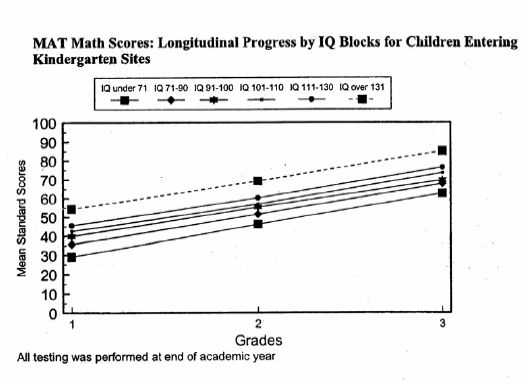
Murray doesn't seem to be aware that the largest educational experiment in American history flatly contradicts his assertion that "[w]e have never known how to educate everyone." Project Follow Through showed us that not only can we get low IQ kids to learn, we can get them to learn at a pace that teaches them a year's worth of material in a year's worth of time. Here's some of the Project Follow Through data broken down by IQ:

Notice how the low performers are keeping pace with the smart kids and how by third grade all the groups, even the ones with IQs below 70, are performing above the median.

While it's true that smart kids can learn significantly faster than this pace, this pace is sufficient to get kids up to the point where they can pass the NAEP exams and the much easier state exams, which is all that our current law requires.

This is going to be a three part series for Murray. Let's hope parts two and three are better than part one.

Interview with Willingham

EdNews has a good interview with Daniel Willingham posted today on "reading comprehension:

6) What are your three main factors that you see as important in reading comprehension?

Decoding, fluency, and background knowledge. Obviously, if you can't decode, it's pretty much "game over." And if you don't have some degree of fluency, you're so occupied with decoding, that you can't pay attention to the meaning of the text. Finally, if you don't have some background knowledge to which you can relate the text, you may comprehend it, but your understanding will be pretty shallow—it will be closely tied to the text itself, and you won't be able to generalize the message of the text.

There you go: decoding, fluency, and background knowledge. Three things that don't get systematicallt taught in your typical balanced literacy classroom.

Here's a question: "To what extent have educators and policy-makes recognized the importance of background knowledge to reading comprehension?" My answer would be "not enough!" I'm specifically concerned about the role of the National Reading Panel report. That Report is becoming crystallized in state and federal legislation as the final word on reading, and the report is great. . . but it's incomplete because it doesn't say anything about the role of background knowledge in reading comprehension. If we're concerned about having students who are good readers we have to recognize that reading is an interaction between the words on the page and the knowledge in the reader's head. Without background knowledge, you can't comprehend a text to a level we would call "understanding." We need to pay attention to developing background knowledge in students from the first day that they are in school, and encouraging parents to do so even before then. It's not a trivial matter to decide what that content should be and how to deliver it. But if we want all children to be excellent readers it has to be done.

Background knowledge: the untaught subject. Read the whole thing.

January 15, 2007

What causes "dyslexia"

Good article in the Telegraph 0n Dyslexia:

Scientists have long asked why some otherwise normal children have difficulty in learning to read, but 650 research studies, which have converged on an intriguing and unexpected answer, have all but solved the puzzle. Most children who find learning to read difficult cannot distinguish the smallest sounds in words. They can hear these sounds but not separate them, which makes it difficult to link them to the letters by which they are represented. The ability to do this – which develops at about the age of five – is called phonological awareness. We are born with varying potential to develop this skill, which has nothing to do with intelligence.

The poorer the skill children inherit, the greater the problem in processing speech sounds and remembering them. Scientists recently discovered that our genes only start the story. What happens after birth is critical; it can cancel out a problem or make it worse: furthermore, it can cause the same neurological weaknesses that other children have inherited. Good parenting and good schooling will, therefore, reduce reading problems.


I'm not so sure that phonological awareness has "nothing to do with intelligence." Lack of PA skills correlates highly with low IQ. In any event, PA skills can be taught, but they are unfortunately not often taught well in most schools.

January 11, 2007

Posting at KTM II

I've been posting some math related articles over at KTM II that you math lovers should check out. Just keep scrolling and reading. And, while you're there check out all the other great posts.

Homeschool regulation: The revenge of the failures

In their never-ending effort to "help" homeschoolers, public school bureaucrats periodically try to increase homeschooling regulations. This makes K-12 education perhaps a unique endeavor: it's a field in which the failures regularly, and astonishingly, insist that they should be able to regulate the successful.

- Bruce N. Shortt

January 10, 2007

Teachers say they cannot cope with needs of dyslexic children

(Cross-posted at KTMII)

As reported in the Independent:

The majority of state school teachers lack confidence in educating dyslexic pupils, a survey for Britain's biggest teaching union shows.

Fewer than one in 14 say they would be "very confident" in identifying a child with dyslexia while only 9 per cent say they would be "very confident" in teaching such a pupil. The survey, by the National Union of Teachers (NUT), reveals the vast majority believe they do not have enough training to deal with special needs children. (emphasis mine

My how quickly they give it. (And, by the way, that is a very unfortunate acronym.)

I'm not convinced that dyslexia is a legitimate disease or handicap or whatever the en vogue euphenism is today. I view dyslexia like the other bogus ailment "specific leearning disability"-- an educator created problem designed to excuse ineffective teaching ability.

I'll give you two good reasons:

1. The MRI evidence they're using to base the dyslexia theory on is bunk (pdf):

[T]he MRI scientists’ interpretation of brain-function data is what is logically referred to as a false dilemma or an argument from ignorance. The scientists observe a correlation between brain patterns and not learning to read.

The possibilities are:
  1. The brain pattern caused the nonlearning.
  2. The nonlearning caused the brain pattern.
  3. The interaction of a third variable caused both the nonreading and the brain pattern.
These scientists apparently don’t consider possibilities 2 or 3, but proclaim that the brain pattern causes the nonlearning. There is no question that there are individual differences in reading performance; however, if the kid can find his way into the right classroom and follow simple directions, he can be taught to read in a timely manner.

2. When kids are taught effectively, the incidence of "dyslexia" drops dramatically:

If it’s true that students in places like the worst slums in Baltimore and rural Mississippi taught with DI have 100% of the children reading—not guessing or memorizing—by the end of kindergarten, something is seriously wrong with the portrait of dyslexia. After all, these students exhibit all of the “warning signs” referred to in the analysis. When they come into kindergarten, they can’t rhyme, they can’t alliterate, they can’t blend orally presented words, and they have lots of problems figuring out unique sound patterns (such as repeating something like 4, 4, 4, 4 and yet are able to repeat four or more random digits). So they should all be dyslexic, and indeed historical performance records show that virtually all of them had been greatly retarded in reading, with the average fifth grader stumbling about on a weak second-grade level. Some of the schools that currently have no nonreaders coming out of K historically had end-of-first-graders scoring at the 6–9th percentile on standardized achievement tests. Yet, the new science tells us that we can expect 1/5 of the population to have dyslexia. That’s a 20% failure rate to teach reading in a fat-cat suburb where parents care about and influence the schools, and where they are lavishly funded with aides, material, and whatever.

You might want to take a look at this article (pdf) as well.

While normal children look at a capital letter R and see R, dyslexic kids are purported to see (backwards R). Normal children see receive; dyslexic children see recieve. Very little of this screwed up perception would actually manifest itself very directly in reading. If a reader actually sees (backwards R)ed, for instance, that child is most likely to say /rred/. If the child “sees” (backwards R) and thinks it’s R that’s not going to cause a decoding problem. If a child sees (backwards R)eb, that could cause a decoding problem, but most letters, written backward, are just backward letters.

Similarly, if the only problem is that a reader looks at receive and “sees” recieve that alone isn’t going to cause any reading difficulty. Look at all the people who write recieve but who think they’ve spelled the word right, and can certainly read what they wrote.

Meet Standardized Testing's Poster Boy

Meet Jordan Davis. He's just failed the Washington state exam (WASL) and can't graduate until he passes. Nothing special about that; half the kids in Washington failed the exam. Here's what caught my eye:

He sat for the WASL math test last spring and failed by two points. He retook it in August and failed by 12. This is a kid who has never gotten below a B in math.

And, that, friends, is the reason why we have NCLB. Quality control.

"I've always been good at math. I always liked math. I totally expected to pass the math WASL," he said in a school hallway last month, exasperated.

Poor kid. You don't know what you don't know.

"We're like guinea pigs in an experiment going wrong," said Caroline Stedman, another Mountlake Terrace High School junior taking a third year of high-school math and a WASL-support class. "It's really ridiculous."

Poor Caroline doesn't realize just how right she is. Her entire educational experience has been one big failed experiment. She's been taught under an educational philosophy that's mostly wrong and has been shown to be ineffective with many students like Caroline.

Falck said it's hard to see her students struggling. "Fifty percent of the kids couldn't pass math with their graduation depending on it. It must be something with the test or something going on in the classroom. It's not the kids' motivation."

So, you're telling me it's not their motivation? That eliminates educator excuse number one. Must be educator excuse number two then -- their parents don't love them. Or could it be educator excuse number three -- we don't have enough money. There is no educator excuse number four.

Here's another poster child:

Stedman defies the stereotype of those who failed the math WASL. Like Davis, she loves math and has always gotten As and Bs. In the past, a learning disability meant she struggled with reading and writing and had to have an Individual Educational Plan — specialized instruction and materials to address her problems in processing words.

When educators finally admit that it's not a "learning disability" but a "teaching disability" we might start making some progress.

Parentalcation

Rory from Parentalcation has a lot of good posts up that you should check out.

I have a similar, but slightly different take, on the affirmative action issue that Rory blogged that I've been meaning to get to. Maybe, tomorrow I will.