January 23, 2009

The real menace of 21st century schools


I think we all agree that schools should be using current technology and teaching students how to use current technology. Kid should know how to use computers, and the internet, and how to use various software packages, etc. I won't go on ad nauseum here; there are lots of education blogs that specialize in using technology.


Actually, what they do often do is oversell the academic benefits of this technology. I love the irony of all these smart and knowledgeable people writing entries for other smart and knowledgeable people to read telling how the only thing holding back dumb people from educational attainment is better access to technology. Like the ditch-digger down the street who can barely put together a coherent though is capable of getting much out of the internet as they do. There's a large gulf between those with only a little bit of knowledge and those with a lot and google isn't capable of bridging it.


But let's not fight about that. There'll always be other posts for that. Let's find something I think we all agree upon: that schools are abusing the call for 21st century skills to draw attention away from the bad job they are currently doing.

Take for example today's top story in the Massachusetts' Standard Times about how Fairhaven High School's new plan to make itself into a 21st Century school which is promised to "equip students with the necessary knowledge and skills to be successful in today's world." As usual the devil is in the details.

Schools seem to follow the same script. First they wipe the slate clean and give the impression that they were doing a marvelous job back in the 20th century, but that simply isn't good enough anymore.

"Even though we're facing these difficult economic times, our commitment to kids has to stay strong," said Fairhaven High School Principal Tara Kohler, who presented the plan to the School Committee last week.

"What we've always done isn't good enough anymore."


Was it ever good enough? I seriously doubt that. We call this change for the sake of change or, more specifically, change for the sake of not establishing a longitudinal track record of bad data. It's much harder to hit a moving target. And, what's the real difference between yesterday's fad and today's. Very little.

After the slate is wiped clean, the new plan is presented in incomprehensible edu-jagon designed to sound much more impressive than it actually is.

The district's plan is centered on five goals:

* Ensuring all students have access to a quality education.
* Preparing students for a 21st-century job market and a global economy.
* Improving students' transitions to high school, thus increasing graduation rates.
* Increasing opportunities for students to take college courses and participate in internships or other school-to-career activities.
* Improving access to technology.


What the hell does this even mean. How is the school going to transform itself into a 21st Century school. Here's how.

While the high school has already made some progress toward these goals — a new computer lab was installed earlier this year and a new transition program for incoming freshmen was implemented — there is still a lot that can be done, according to Ms. Kohler.


They're installing a new computer lab.

That is so 1980's.

There's other assorted nonsense in the school's plan (foreign languages, assorted "green" nonsense, "Virtual High School" online courses, and creating an iPod mobile lab), but none of it is on par with the stuff the edu-tech bloggers get all giddy about.

But don't worry about that the school is now a 21st century school.

Obama effect for reals according to NYT


Sam Dillon of the NY Times breathlessly reports some real educational magic today:

[The]performance gap between African-Americans and whites on a 20-question test administered before Mr. Obama’s nomination all but disappeared when the exam was administered after his acceptance speech and again after the presidential election.

The inspiring role model that Mr. Obama projected helped blacks overcome anxieties about racial stereotypes that had been shown, in earlier research, to lower the test-taking proficiency of African-Americans, the researchers conclude in a report summarizing their results.


This one was so hot the Times couldn't wait for peer review. No need to waste time with that. The Obama effect is for real and it must be reported right this second.

In fairness, Dillion does mention that the study had not undergone peer review, but only provides an incomplete and misleading explanation of prior research on stereotype threat which might have tipped readers off as to the dubiousness of this latest study.

Here are the money grafs from the Wikipedia entry on stereotype threat:

Furthermore, while Sackett et al. do not dispute the fact that stereotype threat has a real, measurable effect on test scores, they posit that in the part of the experiment where Steele and Aronson removed the stereotype threat, the achievement gap which did remain correlated closely with the existing African American - White achievement gap on large-scale standardized testing such as the SAT. In their own words:

Thus, rather than showing that eliminating threat eliminates the large score gap on standardized tests, the research actually shows something very different. Specifically, absent stereotype threat, the African American-White difference is just what one would expect based on the African American-White difference in SAT scores, whereas in the presence of stereotype threat, the difference is larger than would be expected based on the difference in SAT scores.


In subsequent correspondence between Sackett et al. and Steele and Aronson, Sackett et al. wrote that "They [Steele and Aronson] agree that it is a misinterpretation of the Steele and Aronson (1995) results to conclude that eliminating stereotype threat eliminates the African American-White test-score gap."


In the past researchers have been able to depress scores by introducing a stereotype threat (basically, the researchers told the test subjects that they were part of a group that were dummies). Removing the threat only brought scores back up to historic averages. They have not been able, however, to actually increase scores above historic averages.

This new research, in contrast, supposedly shows that test scores can be increased by such a large amount (somewhere between 0.5 to 1.0 standard deviations) to wipe out the achievement gap that exists between blacks and whites. Educationally speaking, that's a giant effect size and a truly unprecedented result (if true). Indeed, the Obama effect must be extraordinary to achieve such a result.

It's basically the educational equivalent of cold fusion. The Times apparently forgot about that lesson in journalistic humility. And so much for acknowledging legitimate opposing viewpoints that might cast some doubts on these extraordinary, unprecedented findings. Get a load of the expert the Times dredged up, replete with some nice spin supplied by the Times.

“It’s a nice piece of work,” said G. Gage Kingsbury, a testing expert who is a director at the Northwest Evaluation Association, who read the study on Thursday.

But Dr. Kingsbury wondered whether the Obama effect would extend beyond the election, or prove transitory. “I’d want to see another study replicating their results before I get too excited about it,” he said.


Kingsbury's wants to see replication -- a prefectly reasonable response. And the Times spins the failure to achieve replication as possibly being cause by "transitory" effects. The expert provides no indication that the results might be in doubt (in fact, he praises the study as "a nice piece of work") and the Times provides no indication that any doubt exists.

The impression I get from the Times article is that the Obama effect is for real, pending peer review, but might fade due to its transitory nature. The Obama legacy is already being written.

Keep your eyes on test results this summer. If we are to believe the Times the achievement gap should be eradicated due to the Obama effect. NCLB will turn out to be a smashing success. And, the world will be a happier place. Unless those nasty transitory effects dash our hopes once again.

January 22, 2009

Today's Video

Good video demonstration showing a real world physics application.

Poster Boy for the Continued Need for Spelling Instruction


Sometimes spell check doesn't cut it.

Where's your google now

I think my physics problem (and nine step solution) demonstrated how difficult it is to think critically about Physics unless you know quite a bit physics and have had quite a lot of practice solving similar physics problems. Your 21st century skills don't seem to be much help here now do they.

RWP also has a post demonstrating the same thing with not one, not two, but three business problems.

And, Pondiscio has, I believe the best post of the week showing how much of President Obama's inaugural speech you missed out on if you lacked the needed historical and literary content knowledge.

For all you connectivists out there I see a pattern emerging.

To paraphrase Edward G. Robinson -- "Where's your google now, nyahhhh?"

January 21, 2009

Twitter Test

All the cool kids seem to be on twitter. So I might as well follow the herd.

See the sidebar on the right for the feed.

follow me on Twitter

More on critical thinking skills and content knowledge

Here's a good passage on critical thinking skills and content knowledge in the context of teaching students to make inferences:

Education has long been enamored with higher order or inference questions. While educators are correct in calling for numerous inferential items, they must realize that large doses of inferential items will not necessarily improve students' inference skills. especially for instructionally näive students. The problem occurs when the inference items assume knowledge and skills the students do not have; and yet, teacher guidance is not provided. For example, consider the inference item: "As the location of the subatomic particle becomes more precise, what would you infer about its momentum?" Or consider this example: "When John walked out onto the street, he nictitated rapidly." Where do you think John has been? These are inference items, but working many items similar to these would not improve an average adult's skill in drawing inferences. Similarly, exposing students, especially low-performing ones, to inference items is not sufficient. The items must be carefully selected and sequenced, and careful instruction must be provided. Students must know relevant vocabulary, assumed relationships,a nd how to draw inferences if practice exercises are to be helpful.


Direct Instruction Reading, 4th edition, p. 237, n.1.

I'm wondering what the readers' reactions are since the opinions seem to span the spectrum.

Let's solve our physics problem

It's time to solve that projectile motion physics problem I gave you last week.

Here's the problem (with my selection of 38.5 m as the distance from the kick point to the cross bar):

A ball is kicked from a point 38.5 m away from the crossbar. The top of the crossbar is 3.05 m high. If the ball leaves the ground with a speed of 20.4 m/s at an angle of 52.2º to the horizontal? (The usual assumptions apply: uniform earth gravity, no drag or wind, the ball is a point)

a. By how much does the ball clear or fall short of clearing the crossbar?

b. What is the vertical velocity of the ball at the time it reaches the crossbar?


Here's a graphic representation of the problem:


We know that the ball is kicked at an initial speed of 20.4 m/s at an angle of 52.2º. As such, the ball will be travelling both upwardly (vertical component) and to the right (horizontal component). Gravity will also be acting on the ball and pulling (accelerating) it back down to earth.

So, our problem is governed by the "what goes up, must come down" law of motion. In our case the ball gets kicked. It goes up. Then it comes back down. In between the going up and the going down parts of the trip, the ball reaches its maximum height.

We can easily calculate the maximum height (vertical distance travelled), the time it takes the ball to reach this maximum height, and the horizontal distance the ball travels during this time. Once we know these values we can determine where the crossbar is in relation to the maximum height reached by the ball. Does the ball pass the crossbar while it's going up or while it's going down? Both possibilities are shown in the picture.

Once we figure this out, then we'll worry about solving the rest of the problem.

So let's get to it and use some 21st Century skills. But, notice the amount of domain specific critical thinking that had to be done beforehand.

Let's google "projectile motion calculator" and select the first link.

Pay Dirt -- a projectile motion calculator presented as an HTML form. Filling out an HTML form seems to be a good example of a 21st Century skill, so let's use it.

The first two input fields call for an initial velocity (in m/s) and an angle (degrees). We know those values -- 20.4 and 52.2. Let's enter in those values and select Horizontal Component of initial velocity, Vertical Component of initial velocity, Max Height, Time to reach max height, Time of flight, and Range of flight as the things we want the calculator to calculate. The more the merrier. Computation time in the 21st century is cheap and this case nearly instantaneous.

Here's what the calculator spits out:

Horizontal Component of initial velocity: 12.503 m/s
Vertical Component of initial velocity: 16.119 m/s
Max Height: 13.256 m
Time to reach max height: t = 1.645 s
Total Time of flight = t = 3.290 s
Total distance travelled = 41.131 m


Wow. That saved me quite a bit of effort remembering and applying algebra, trigonometry, and physics. I think I like these fancy 21st Century skills.

Now let's put our critical thinking caps back on and make some sense of these numbers.

The calculator told us that the total time of flight (3.290 s) was merely double the time it took to reach the maximum height (1.645 s), i.e., it takes the same amount of time for the ball to travel up that it does to travel back down. This means that the distance to reach the maximum height is half of the total distance travelled 41.131 m ÷ 2 = 20.5655 m.

Since the cross bar is 38.5 m away from the starting point and the maximum height is reached at 20.5655 m, then the ball reaches its maximum height before it reaches the crossbar. So, the ball will be on its way back down to earth when it crosses the crossbar. This condition is shown in the picture and is the crossbar on the left hand side.

At the maximum height the ball is 13.256 m high and the crossbar is only 3.05 m high. The question is will the ball still be above the crossbar when it reaches the horizontal distance of the crossbar.

First we have to figure out how much farther the ball has to travel horizontally between the maximum height (20.5655 m) and the distance to the crossbar (38.5 m). This is simple subtraction (38.5 - 20.5655): 17.9345 m. The ball has 17.9345 m left to travel horizontally befoe it reaches the crossbar.

The calculator tells us that ball is travelling at a horizontal speed of 12.503 m/s.

I'm hoping that most people know that distance travelled = speed x time travelled. Or time travelled = distance travelled ÷ speed. In our case, the time it takes to traverse those 17.9345 m is (17.9345 m ÷ 12.503 m/s) 1.434 s.

Now the question is how far will the ball fall down during those 1.434 s.

That seems like real physics to me. So let's see if we can find another calculator to do the dirty work. As luck would have it the second link of our google search has just what we need. This page has a bunch of different projectile motion calculators. Again, as luck would have it, the top one "freefall" is the one we need (though you probably didn't know that unless you knew some physics).

The freefall calculator asks only for a time of travel. We just calculated that time as 1.434 s. Punching that number in, we find out that:

The vertical speed of the ball is 14.0532 m/s downward and the ball travels 10.076 m. So, the ball falls 10.076m from its max height of 13.25 m. so the ball is (13.25 m - 10.076 m) 3.174 m above the ground when it reaches the crossbar. The crossbar is only 3.05 m high, so the ball just barely clears the bar.

Now we have all the information we need to answer the problem.

Answer A: The ball clears the bar by (3.17 m - 3.05 m) 0.12 m.

Answer B: The ball's vertical velocity is 14.1 m/s downward according to the calculator.

We can check our answer by filling in our numbers in the "will it clear the fence" calculator toward the bottom of the page The answer does indeed check out.

Done and done.

We'll discuss the results in another post.

January 20, 2009

Today's Quote

Comes from Robert Pondiscio of the Core Knowledge Blog on whether content knowledge is part of most school's reading instruction curriculum:

[R]eading strategies, “child-centered” teaching and differentiated instruction are joined at the hip. When you have heterogeneously grouped classes, all reading self-selected books based on individual interest and reading level, then instruction can no longer be about the text. It has to be about a generalized skill that can be applied to any text. Or any child.


I agree.

Today's predominate balanced literacy instruction precludes teaching content knowledge.

In fact, I'd add the following codicil.

Whole language, reading strategies, “child-centered” teaching and differentiated instruction are joined at the hip. When you have heterogeneously grouped classes, all reading self-selected books based on individual interest and reading level based on readability formulas, then instruction can no longer be about the content and decodability of the text. It has to be about a generalized skill that can be applied to any text. Or any child. And, the instructional advantages conferred by using phonics is greatly diminished.


Let's call it the Pondiscio-DeRosa rule of reading instruction

Let's Put an End to Tappa Tappa Tappa

The Simpsons episode, Last Tap Dance in Springfield, from season 11 has a wicked take on the instructional status quo.

In the episode Lisa decides she wants to learn how to tap dance despite not being very good at these kinds of athletic endeavors. Lisa signs up for classes at a dance studio run by Little Vicki, a former child star along the lines of Shirley Temple. Little Vicki personally teaches the children's tap dancing class.

Vicki: Now, the key to great dancing is one word: tappa-tappa-tappa.

[the children exchange looks]

Vicki [demonstrating]: Tappa-tappa-tappa.

[the children try]

Many tappa-tappa-tappas later, the class progresses nicely. Then Vicki notices someone off the beat. Vicki has Lisa dance by herself. She loses her balance and falls over backwards into a potted plant. The class laughs at her.

Vicki: Children, stop it! For all you know, she has a medical condition.
Lisa: Nope.
Vicki: I see....


Lisa continues to have trouble staying upright. Lisa blames it on the floor and moves to one end of the room, where she falls down again. Little Vicki dismisses the class for five minutes to talk to Lisa.

Lisa: What am I doing wrong, Little Vicki?
Vicki: Well, you're falling a lot. Maybe you should work on that.
Lisa: Yeah, well, no offense, but maybe I need a little more instruction than just "tappa-tappa-tappa".
Vicki: Why, back when I was your age, I had 43 movies under my belt, and I had to do it without tappa-tappa-tappa. I would've killed for tappa-tappa-tappa.
Lisa: Sorry, I'm just frustrated.
Vicki: Well, you'll never save Grandpa's farm with that attitude! You've just got to turn that frown upside-down!
[Lisa smiles]
Vicki: That's a smile, not an upside-down frown! Work on that, too!

Much of what goes on in elementary education is just a bunch of tappa tappa tappa. "Try reading this non-decodable children's good. Can't do it, then try looking at the pictures or the first letter of each word for cues. Still can't do it, then its time to call in the reading specialist."

Here's how the segment ends.

After class Lisa goes home and dejectedly walks through the kitchen, still wearing tap shoes:

Marge: There's our Broadway baby!
Lisa: [groan]
Marge: Hey, dig that crazy rhythm!
Lisa: I'm just walking. Listen, I know I said I wanted to be a dancer, but--
Marge: And you WILL be a dancer!
Homer: Look at you, all sugar and spice instead of equations and test tubes. [puts Lisa on his lap] You're Daddy's precious dancing queen.
Marge: And you look adorable!
Homer: Now, honey, what were you trying to say before we kept interrupting with our loving proudness?
Marge: Yes, our tiny tapper, what was it you were going to say after "I wanted to be a dancer, but"?
Lisa: But, I just... [looks at her proud parents] ...need more practice! See ya! [exits the kitchen, with her shoes tapping]
Homer: Oh, what's that awful sound?
Marge: The furnace?
Lisa: It's me!
Homer & Marge: Aww....


Perfect.

January 17, 2009

McWhorter and Yglesias on DI

John McWhorter believes that DI is a "solution for the reading gap" between white students and black and/or poor students:

Starting in the late 1960s, Siegfried Engelmann led a government-sponsored investigation, Project Follow Through, that compared nine teaching methods and tracked their results in more than 75,000 children from kindergarten through third grade. It found that the Direct Instruction (DI) method of teaching reading was vastly more effective than any of the others for (drum roll, please) poor kids, including black ones.


This is true as far as it goes, but only part of the story: The results from PFT were a bit more conclusive than WcWhorter lets on. Here's how Zig describes the results in chapter 5 of his last book.

The evaluation had three categories: basic skills, cognitive (higher-order thinking) skills, and affective responses.

The basic skills consisted of those things that could be taught by rote—spelling, word identification, math facts and computation, punctuation, capitalization, and word usage. DI was first of all sponsors in basic skills...Only two other sponsors had a positive average. The remaining models scored deep in the negative numbers, which means they were soundly outperformed by [the control group]

DI was not expected to outperform the other models on “cognitive” skills, which require higher-order thinking, or on measures of “responsibility.” Cognitive skills were assumed to be those that could not be presented as rote, but required some form of process or “scaffolding” of one skill on another to draw a conclusion or figure out the answer. In reading, children were tested on main ideas, word meaning based on context, and inferences. Math problem solving and math concepts evaluated children’s higher-order skills in math.

Not only was the DI model number one on these cognitive skills; it was the only model that had positive scores for all three higher-order categories: reading, math concepts and math problem solving. DI had a higher average score on the cognitive skills than it did for the basic skills...

Not only were we first in adjusted scores and first in percentile scores for basic skills, cognitive skills, and perceptions children had of themselves, we were first in spelling, first with sites that had a Headstart preschool, first in sites that started in K, and first in sites that started in grade one. Our third-graders who went through only three years (grades 1-3) were, on average, over a year ahead of children in other models who went through four years—grades K-3. We were first with Native Americans, first with non-English speakers, first in rural areas, first in urban areas, first with whites, first with blacks, first with the lowest disadvantaged children and first with high performers.


You see the problem? DI wasn't just effective with poor/black students; it's effective with all students. In the long run this success is going to militate against eliminating achievement gaps, though a relative long-term reduction might be possible.

McWhorter continues:

DI isn't exactly complicated: Students are taught to sound out words rather than told to get the hang of recognizing words whole, and they are taught according to scripted drills that emphasize repetition and frequent student participation
.

On a superficial level DI does not appear to be complicated. But, DI requires a lot more than "sounding out words" and "scripted drills" to work effectively. These are superficial features of DI. SOmeone with a deep understanding of DI would focus on other features, such as mastery learning.

Matt Yglesias basically agreees with McWhorter's somewhat superficial analysis but cautions:

A word of caution I would offer is that the rhetoric in the column seems, in my view, to oversell this fix. I think it’s important not to set people up to believe that some proposed change is a silver bullet when that just sets the stage for a potential future backlash. Based on what we know, it would be much better in general—and especially for poor kids—to do more direct instruction.


Yglesias is also confused. Like, McWhorter he identifies phonics as the primary component for DI's success. This isn't accurate. Moreover, McWhorter is talking about Direct Instruction. Yglesias is talking about direct instruction; the two are not the same. McWhorter is overselling DI a bit. He's also underselling it as well. So, Yglesias's concerns are only partially probative here. Yglesias's concern of a "potential future backlash appears to be based on the following:

Even the most egalitarian countries have statistically meaningful achievement gaps, and the United States is far from being the most egalitarian country.


Believing that egalitarian policies, or lack thereof, are somehow the cause of achievement gaps is a good example of what you get when you use correlational studies without understanding the underlying issues. Just because poverty and educational achievement are correlated and egalitarian policies and achievement are also correlated, does not mean that egalitarian polcies cause increased student ahcievement. See La Griffe's latest analysis to see why this is not so.

Yglesias does appear to stumble upon the right answer in the end though:

There’s no “solution” to the general existence of achievement gaps. There are, rather, policies that can be effective in narrowing them and this is one.


Even though the rest of his comment is wrong. Funny how that works sometimes.

January 16, 2009

Philly Schools Can't Give Free Food Away


The Philadelphia Inquirer reports that:

Just one in three low-income students eligible for free or reduced-price breakfasts got those meals in Philadelphia schools during the 2006-07 school year, according to a national report released yesterday.

...

Since the 2006-07 school year, however, the district has worked to improve the situation, a district spokesman said. But problems persist in the surprisingly complex and nuanced world of school breakfast.


So now serving breakfast is too complex and nuanced for schools to deliver.

Remember the hullabaloo a few months back regarding the community schools and the desire for schools to take over a whole panoply of social services.

Now we find out they can't even serve breakfast effectively. And, breakfast is very similar to lunch, something they've been doing for a long time.

And I don't want to hear that the schools don't get enough subsidy for these meals. We went to Disney World last month and the Disney Dining Plan was $9.99 for children who received a counter service lunch, a full restaurant table service dinner and a snack that could include almost any food product sold by Disney for about $3.50, including many breakfast items.

Contrast this to the french fries served by my high school whose box read "no nutritional value but edible." Mmmmm-mmmm.

January 14, 2009

21st Century Skills and Real World Problems

So how much does possessing 21st century skills compensate for a lack of domain knowledge?

Can you think critically in a domain in which you do not have a deep understanding?

Some in the edusphere think you can.

I think lack of domain knowledge will serious handicap your ability to think critically in that domain.

Instead of arguing and accomplishing nothing, why don't we collect some data.

And I urge everyone in the edusphere who has an opinion in this area to think up their own example.

Below is a simple physics problem that requires some domain knowledge in physics, algebra, and arithmetic to solve. And, unless you've seen a problem very similar to the one below, I think you'll need a somewhat deep understanding to come up with a solution.

At least before the 21st century and the internet.

I've taken 2 years of physics (one in high school and one in college) and a semester of dynamics. I have some domain knowledge in physics. But, I took these courses over 20 years ago and I haven't had much need to solve these kinds of problems since then. However, I still remember how to solve these problems with a little prompting because I solved a few hundred similar problems two decades ago. It's in long term memory at this point.

And, indeed, I was able to solve the problem in about five minutes with a pencil, paper, and a calculator with trigonometric capabilities.

Then I turned to the internet and tried to solve it using knowledge I could extract therefrom. Not unsurprisingly, the internet offered a cornucopia of information that greatly assisted me and made the job of solving the problem much easier. I didn't have to use any algebra nor did I have to do any manual computation. And, the tools I found had brief descriptions of the underlying physics, so I'm thinking a non-expert might be able to use them without really knowing or understanding the underlying physics all that well.

Again, I was able to solve the problem using the internet in about five minutes. But, again, I have domain knowledge.

In theory, the problem can be solved using general critical thinking skills and a basic understanding of how the world works if one has access to the internet.

Let's put that theory to the test.

Here is a simple physics problem that any high school student taking physics is capable of solving. You've probably taken high school physics, but you probably don't remember much of it if you didn't go on to take more physics in college.

See if you can use your critical thinking skills to solve it. Use your 21st century skills to help you solve it. Here it goes.


A ball is kicked from a point X m away from the crossbar, where X is a number between 38 and 39 that you select. The top of the crossbar is 3.05 m high. If the ball leaves the ground with a speed of 20.4 m/s at an angle of 52.2º to the horizontal? (The usual assumptions apply: uniform earth gravity, no drag or wind, the ball is a point)

a. By how much does the ball clear or fall short of clearing the crossbar?

b. What is the vertical velocity of the ball at the time it reaches the crossbar?


Just pick a random number between 38 and 39 and off you go. (I did this so that everyone would get a different answer).

It may be that I picked too simple of a problem. (I always underestimate the amount of math that non-science/engineering majors know and I didn't want to make the problem too hard.) But I think what the problem will demonstrate is that without domain knowledge in physics you will be overwhelmed by the problem and will have much difficulty in doing all the steps needed to answer the questions.

(I did not find any tools that allowed you merely to plug in the numbers and pop out and answer. That would not require any critical reasoning.)

Leave your answers and comments in the comments of this post. Don't forget to tell us what number you selected (between 38 and 39).

And for all of you edusphere bloggers why don't you use your specific domain knowledge and come up with your own critical thinking problems to test and challenge your readers and your own opinions on critical thinking and 21st century skills.

Update: No fair using the pre-21st century skills as asking someone else for help or a complete solution or to learn the specific domain knowledge needed. I wouldn't be able to have chosen such a simple problem if I allowed that and I can certainly have found a more difficult problem in which you could not have learned the domain knowledge in a reasonable amount of time.

Don't spend more than about 20 minutes or so solving the problem.

Also, don't give away too much information in your comments. We don't want other readers using your methodology to find their own solutions. But do tell us the amount of domain knowledge you think you possess. And do tell us if you can't solve the problem within the constraints.

I will make a new post in a few days where you'll be able to leave more detailed information as the discussion gets furthered.

January 13, 2009

Follow-up on the last post

I don't want anyone to get the idea that I necessarily favor the old lecture model over the new bite-size lecture model. I just don't see much of a difference. At least for introductory physics.

If anything, the new model has some potential advantages in keeping students fully engaged during class. This advantage is contingent upon the student being capable of being kept engaged during class which requires that the student prepare for class by reading and thinking about the material beforehand. This is not something the non-physics M.I.T students are willing to do, at least according to the article.

I jut don't see how an unprepared student can effectively participate in a problem solving activity with only a few minutes of teacher talk.

Here's a good example of what I'm talking about. Projectile motion is one of the first and easiest topic in introductory physics. See if you can read the explanation and then see if you can solve the problems in real time. Now go find five friends who don't know Physics and see if it helps when you try together. The example provides a good introductory explanation. I'm sure someone knowledgeable in Physics, like a grad student, would help out a bit. But, I'm thinking that it would be a lot more helpful, if you were presented the initial explanation first, then you were given a few hours to wrap your head around the material and try your hand at solving a few problems. Then you would know exactly what you knew and what you need more help with. That's when the grad student comes in handy. And, that's why the traditional way Physics is taught works well for those that do the work. It also tells us that there is no shortcuts no matter what M.I.T and the NYT wants you to believe.

M.I.T Drops Physics Lectures; NY Times Confused

The NY Times "reports" that M.I.T. has dropped its Introductory Physics lectures in favor of "smaller classes that emphasize hands-on, interactive, collaborative learning." Dropping the lecture is probably a good thing; but, the Times article makes little sense. Probably because the reporter, Sara Rimer, doesn't seem to understand the nature of science instruction and doesn't provide enough information for the reader to understand what's going on here.

Introductory Physics is a typically a four credit class. Actually, two semesters of four credits. This means that there's four hours of classroom instruction provided each semester. Typically, these courses are followed by (at least) a two credit lab course in which students take what they've learned and conduct highly scripted Physics experiments.

Here's how Introductory Physics is traditionally presented in a typical school week.

1. Student reads the next section in the textbook.
2. Professor explains the section, provides his insights, and works some problems from the section. (one hour)
3. Student attempts to solve the assigned problems from the section, either alone or in a study group.
4. Grad Students work with students in small groups reviewing the problems to ensure the student understands the material. (one hour)
5. Repeat steps 1-4 for next section. (two hours)

That's how it's supposed to work. In practice, it usually goes a little differently.

1. Student fails to read next section or doesn't understand next section.
2. Professor reviews exactly what is written in the textbook without providing any insight that the student could have gotten by reading the book on his own.
3. Student fails to do some, many, or all of the assigned problems either through lack of understanding or laziness.
4. Grad student reviews problems and student copies answers.
5. Repeat.

Note that the student is supposed to be spending at least eight hours a week studying and solving problems outside of the classroom. Some students front-load the work and do their work before the material was presented and the problems are reviewed like in the first example. Other students back-load the work and do their work after the material was initially presented and the problems solved like in my second example. Most students, however, fall out somewhere in the middle.

This is basic direct instruction using worked problem examples. Research shows that it is an effective way to teach novice students, and, by definition, students taking an introductory Physics class are novice students. These students have a long way to go before they are experts in Physics. Using worked problem examples is less effective with experts and non-novices with considerable domain knowledge. The difference is domain knowledge. The experts have it; the novices do not, at least not yet.

In fact, they won't have it the following semester either when they take Physics lab. Undergraduate Physics lab is closer to baking a cake from scratch than it is to real science. It is a highly scripted affair because the students do not yet know enough physics or how to conduct a real experiment on their own yet. They are novice scientists and the lab provides another opportunity to follow worked problems. In this case, the worked problems are the scripted experiments.

I think now we have enough background knowledge to make some sense out of the Times article.

For as long as anyone can remember, introductory physics at the Massachusetts Institute of Technology was taught in a vast windowless amphitheater known by its number, 26-100

...

The physics department has replaced the traditional large introductory lecture with smaller classes that emphasize hands-on, interactive, collaborative learning. Last fall, after years of experimentation and debate and resistance from students, who initially petitioned against it, the department made the change permanent. Already, attendance is up and the failure rate has dropped by more than 50 percent..


Right off the bat, I find it hard to believe that all four hours classroom time in Introductory Physics are present in a large ampitheater. Are there any science/engineering majors (especially those attending M.I.T) out there that that were taught like this. Undergraduate physics instruction is all about learning how to solve basic physics problems. BY necessity this will involve the student working hundreds of problems over the course of the semester on his own or with a study group. There's no getting around that fact. Even the most direct instruction of courses requires that the student work the problems on his own following an introduction by an expert (the professor) and concluding with a review of the problems with an expert (a grad student or the professor). This requires motivation on the part of the student. And that appears to be a problem at M.I.T, as you'll soon see.


Also note the petitioning of the students adn the failure of the Times to get to the bottom of that. We'll get to that later.


The traditional 50-minute lecture was geared more toward physics majors, said Eric Mazur, a physicist at Harvard who is a pioneer of the new approach, and whose work has influenced the change at M.I.T.

“The people who wanted to understand,” Professor Mazur said, “had the discipline, the urge, to sit down afterwards and say, ‘Let me figure this out.’ ” But for the majority, he said, a different approach is needed.


I think Professor Mazur is delusional. Physics forms a critical foundation for most of the students learning a hard science or engineering. Subsequent courses will build off of what is learned in introductory physics and the physics problems will be revisited and expanded upon often in subsequent years. So, a student who does not possess the urge to put in the hard necessary to learn physics is in for a rude awakening sophomore year. The years of coddling in high school are over; now is the time for real work.

“Just as you can’t become a marathon runner by watching marathons on TV,” Professor Mazur said, “likewise for science, you have to go through the thought processes of doing science and not just watch your instructor do it.”


That's stating the obvious now isn't it. And I find it hard to believe that M.I.T students were merely watching their instructor solve problems for four hours every week in a large amphitheater and not actually solving their own problems. I'm sure somewhere along the line students were being assigned problems to work out of class and that some time in-class was spent reviewing those problems and their solutions. Are we to believe that only the Physics majors were doing their homework?

Then we have this non-sequitur.

In an article in the education journal Change last year, Dr. Wieman noted that the human brain “can hold a maximum of about seven different items in its short-term working memory and can process no more than about four ideas at once.”

“But the number of new items that students are expected to remember and process in the typical hourlong science lecture is vastly greater,” he continued. “So we should not be surprised to find that students are able to take away only a small fraction of what is presented to them in that format.”


What does this have to do with anything related to this article. The magic number 7 is a problem under both the old way and the new way at M.I.T. Either way, the students are learning more than they can absorb. That's why they take notes and write stuff down. Students really bump up against the short term memory problem when they try to solve the problems until they have learned the underlying material. The new way of teaching doesn't fix that problem. The only thing that fixes that is lots of practice solving problems. Are the students getting more practice under the new system? Let's see.

At M.I.T., two introductory courses are still required — classical mechanics and electromagnetism — but today they meet in high-tech classrooms, where about 80 students sit at 13 round tables equipped with networked computers.

Instead of blackboards, the walls are covered with white boards and huge display screens.


Why are journalists such suckers for bright lights and fancy gizmos? I've yet to see any of this technology used in a way that is pedagogically superior to a blackboard and a slide projector.

Circulating with a team of teaching assistants, the professor makes brief presentations of general principles and engages the students as they work out related concepts in small groups.

Teachers and students conduct experiments together. The room buzzes. Conferring with tablemates, calling out questions and jumping up to write formulas on the white boards are all encouraged

This is the money graf. Here's where we find out that M.I.T hasn't really done away with the lecture, they've just shuffled the chairs. Instead of Lecture for an hour in a classroom and then solve problems for an hour in small groups with grad students, M.I.T. now has the professor lecture for a short period of time then the students solve problems for a short period of time with the help of the professor and grad students in the same room, repeat until the class is done. What's the difference?

I don't see the advantage, except maybe that the lazy students are being forced to do the work under the watchful eyes of the instructors instead of copying the problems they should have worked out before a later problem solving period. But, since they're working in groups now, there's no guarantee that they're not free-riding off of their neighbors instead of free-riding off of the grad student in the separate recitation period.

What the article describes is exactly what was going on in our problem solving classes with our grad student after our lecture. The only change is that we had blackboards.

M.I.T hasn't done away with the lecture; they've merely rearranged it in a way that is no more sound in a cognitive science sense than it was before. What M.I.T. is doing is providing another year of coddling. It's also still direct instruction. (Though I can't wait to see how Stephen Downes is going to try to spin it.)

And, the students aren't experimenting, they are solving problems. There is a big difference.

“There was a long tradition that what it meant to teach was to give a really well-prepared lecture,” said Peter Dourmashkin, a senior lecturer in physics at M.I.T. and a strong proponent of the new method. “It was the students’ job to figure it out.”


Our professor gave some really good lectures and then he ran one of the problem solving sessions. Is there a difference?

Apparently the problem is really an attendance problem.

John Belcher, a space physicist who arrived at M.I.T. 38 years ago and was instrumental in introducing the new teaching method nine years ago, was considered an outstanding lecturer. He won M.I.T.’s top teaching award and rave reviews from students. And yet, as each semester progressed, attendance in his introductory physics courses fell to 50 percent, as it did, he said, for nearly all of his colleagues.

“M.I.T. students are very busy,” Professor Belcher said. “They see the lecture as dispensable, that is that they can get it out of a book more efficiently than getting up, getting dressed and going to lecture.”

After three years, Professor Belcher had had enough. “I had poor attendance, and was failing 10 to 15 percent, and grading the tests and shaking my head in despair about how little was getting across,” he said. “And this is a subject — electromagnetism — that I love.”


Here's the thing. The problem solving sessions are critical to success. The lectures less so if the textbook presents the material well and the student reads it beforehand. This is especially so if the professor is a bad teacher. Under the new system the students are forced to endure the gas-bag "initial presentation,"i.e., mini-lectures, to get to the problem solving part.

Maybe that's why the students are petitioning. The silly lectures are no longer optional for the student. That's why attendance is up. Here's another reason why attendance is up:

Unlike in the lectures, attendance counts toward the final grade, and attendance is up to about 80 percent.


I suppose the clickers don't hurt.

“One of the newer professors, Gabriella Sciolla, who arrived in 2003, was teaching a TEAL class on circuits recently. She gauged the level of understanding in the room by throwing out a series of multiple-choice questions. The students “voted” with their wireless “personal response clickers” — the clickers are essential to TEAL — which transmitted the answers to a computer monitored by the professor and her assistants.

You know where they are,” Professor Sciolla said afterward. She can then adjust, slowing down or engaging students in guided discussions of their answers, as needed.

Lecturing in 26-100, she said, she could only look out at the sea of faces and hope the students were getting it.


Unless they had clickers because if they had clickers in the lecture hall, the professor would get the same feedback.

What I see here is a distinction without a difference. The learning is no more active then it was under the old system.

What is left unexplored by the Times is why there was protesting by the students. Students are no fans of boring lectures. And I'm sure under the old system there was plenty of in-class problem solving and opportunity for feedback. Under the old system students were supposedly left on their own to solve difficult physics problems. Now they get to do the same thing in a high-tech classroom with all their classmates and lots of teaching assistants milling around. So why the protests?

I suspect once we learn why, we'll get a better idea of the problems of the new system at M.I.T.

January 9, 2009

Teaching Content is Teaching Reading

Dan Willigham has a new video up on the importance of content instruction in reading and comprehension. Willingham and Don Hirsch have making these same points for some time now. But the video makes this information more accessible.


BTW, Willingham also has a new article on memory in the new American Educator which you should also read.

And, would you believe that I actually beat the inestimable Core Knowledge Blog in posting the video. Take that Pondiscio.

January 8, 2009

Spelling tackled in American Educator

Following my lead, American Educator has a good article on Spelling and how to teach it.

Not unsurprisingly, popular spelling instruction practices are based on flimsy pseudo-science:

One common perception we have encountered is that visual memory, analogous to taking a mental picture of the word, is the basis of spelling skill. Teachers often tell us that they teach spelling by encouraging whole-word memorization (e.g., using flashcards and having students write words 5 or 10 times) or by asking students to close their eyes and imagine words. We’ve encountered this perception that spelling relies on visual memory so many times that we became curious about when and how it originated—after all, it’s a far cry from Webster’s spellers. We traced it back to the 1920s: one of the earliest studies to stress the role of visual memory in spelling was published in 1926, and it found that deaf children spelled relatively well compared with normal children of similar reading experience.4 Based on this study, and the perception that the relationship between sounds and the letters that spell them is highly variable, many people concluded that learning to spell is essentially a matter of rote memorization. Thus, researchers recommended that spelling instruction emphasize the development of visual memory for whole words


Right, let's have them visually memorize whole words because there couldn't possibly be any other helpful information they could use. Apparently not; its a common belief that English is a highly irregular language. The article lays that trope to rest.

This is a question we hear often. If English spelling were completely arbitrary, one could argue that visual memorization would be the only option. However, spelling is not arbitrary. Researchers have estimated that the spellings of nearly 50 percent of English words are predictable based on sound-letter correspondences that can be taught (e.g., the spellings of the /k/ sound in back, cook, and tract are predictable to those who have learned the rules). And another 34 percent of words are predictable except for one sound (e.g., knit, boat, and two). If other information such as word origin and word meaning are considered, only 4 percent of English words are truly irregular and, as a result, may have to be learned visually (e.g., by using flashcards or by writing the words many times).

Far from being irregular and illogical, to the well-known linguists Noam Chomsky and Morris Halle, English is a “near optimal system for lexical representation.

...

There are three types of information that, once learned, make spelling much more predictable: (1) word origin and history, (2) syllable patterns and meaningful parts of words, and (3) letter patterns.”


It doesn't take a rocket scientist to figure this out. Research shows that children misspell irregular words more often than regular words. That should have been a good indication that visual memorization might not have been the best way to go.

The other thing is. Wouldn't using word origin and history, spelling patterns and meaningful parts of words, and letter patterns to spell words involve using and practicing critical thinking skills -- dare I say 21st Century skills, rather than brute memorization? Just sayin'.

The article is a good read. The only weak part is when the authors make some untested recommendations as to how they think spelling should be taught. At best, these recommendations are representative examples of what might possible be good practice once someone takes to time to develop an test a suitable instructional sequence. But, that work has not yet been done and the authors are a wee bit overconfident that their recommendations will be effective.

January 7, 2009

21st Century Skills

Jay Mathews has a good editorial on the inanity of the latest education fad, teaching 21st Century skills.

Granted, the 21st-century skills idea has important business and political advocates, including President-elect Barack Obama. It calls for students to learn to think and work creatively and collaboratively. There is nothing wrong with that. Young Plato and his classmates did the same thing in ancient Greece. But I see little guidance for classroom teachers in 21st-century skills materials. How are millions of students still struggling to acquire 19th-century skills in reading, writing and math supposed to learn this stuff?

There are ways, some teachers tell me. Tim Burgess, a physics and chemistry teacher in Alabama, said he tried coaxing students to think for themselves. He laid out clues and let students sort them out together -- and it worked. "Suddenly, it became clear how 21st-century thinking was far more important than the mounds of content we were expected to force-feed our victims (I mean students)," Burgess said.


The 21st Century skills movement is nothing more than an excuse for continuing not to teach content under the mistaken belief that if you teach students how to think (i.e., how to learn how to learn), content becomes irrelevant internet access.

Unfortunately that's not the way it works. Critical thinking skills are domain specific. If you want to think critically about the American Civil War you unfortunately need to know a lot of stuff about American history, European History, military history, the American Civil Wat itself, and lots of other bring stuff like that.

This doesn't necessarily mean that students need to spend lots of time memorizing minutiae, but they at least know enough general knowledge to be able to pass those silly internet tests that embarrassingly show that today's (and yesterday's) students don't, in fact, know this stuff. There must be some sort of mental framework in place for Google or Wikipedia to be useful.

Instantaneous access to information doesn't guarantee that one will know what to do with the information after it's located.

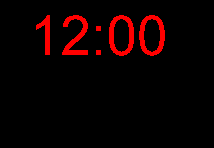
Although, I think there is one useful 21st Century skill that students should be taught: how to set the time on their VCR's to lose that technological incompetence badge of shame: 12:00.

Or maybe not.

(That lame ending joke is actually a good example of what I'm talking about. It depended upon my knowing a few pieces of minutiae: 1. That there is an annoying blinking HTML tag (something I've known for some time) and that VCRs are no longer being manufactured (something I learned last week). And my being able to quickly retrieve those facts in real time as an example of obsolete skills, the importance of knowing facts, and critical thinking (the ability to synthesize those facts to make the joke) to end the post. The other point is that a good comedian should never have to explain his jokes. I leave it up to you to deconstruct that one in the comments.)

Update 1: Apparently, IE doesn't properly display the BLINK HTML tag. That's probably a good thing. Use your imagination.

Update 2: Willingham beat me to the punch. "But these 21st-century skills require deep understanding of subject matter, a fact that these reports acknowledge, albeit briefly. As I have emphasized elsewhere, gaining a deep understanding is, not surprisingly, hard. Shallow understanding requires knowing some facts. Deep understanding requires knowing the facts AND knowing how they fit together, seeing the whole. It’s simply harder. And skills like “analysis” and “critical thinking” are tied to content; you analyze history differently than you analyze literature, a point I’ve emphasized here. If you don’t think that most of our students are gaining very deep knowledge of core subjects—and you shouldn’t—then there is not much point in calling for more emphasis on analysis and critical thinking unless you take the content problem seriously. You can’t have one without the other."

Update 3:

January 5, 2009

Bamboozling the Gifted

One of the reasons I've been neglecting the blog is that I've been forced to learn Pennsylvania's rules for gifted education.

Here's how gifted education is supposed to work according to the statute:

1. Student is identified as being gifted, i.e., an IQ of two standard deviations above the mean (with some leeway which allows schools to fudge the results a bit for students just missing the cutoff).

2. The gifted student's present level of educational performance is then determined to see where the student is academically. For example, a third grade student might be reading on a fifth grade level and doing math on a fourth grade level.

3. Then the student's instruction is supposed to be specially designed, i.e., individualized, to meet the needs of the student.

4. Annual goals (what the student is supposed to learn this year) and short term learning objectives (the steps the students is to take to learn the goals) are then developed.

5. And the whole plan is memorialized in a written document (GIEP) which must be approved by the student's parents.

That's how things are supposed to work in theory. In actuality, things typically work a little differently. Here's how it works in practice in most school districts:

1. Student is identified as being gifted.

2. School district recommends that the student particpate in its gifted pull-out program which typical entails "enrichment" not acceleration.

3. Student receives some "differentiated" school work (i.e., semi-random worksheets) in class (because the courts have determined that a gifted pull-out program is not sufficient by itself).

4. Fuzzy goals and learning outcomes are listed in the student's educational plan which are typically subjective, unquantifiable, and/or untestable.

5. Plan is presented to student's parents for approval without informing them that the district's recommendation is merely a preference and that other options are available tp the student.


I'd characterize this as the school's way of discharging the regulatory burdens of providing gifted education with the minimal amount of work and the minimal amount of additional academic expectations. Instead of the student's needs being paramount as intended by the law; the disctrict's administrative convenience is paramount.

As a parent of a regular education student you basically have no say in how your child is educated in the public school system. You don't agree with the school's choice of fashionable curriculum? Too bad; move to a new a new school district. But once your child is identified as gifted (or "special" at the other extreme) they become statutorily protected. Now the parent does have a say. But unfortunately, most parents willingly (if perhaps unwittingly) sign away this right as soon as they accept the district's recommendation which is, as I described above, designed to specifically appear to be doing something for the student without doing much of anything or being responsible for doing or accomplishing much of anything.

The school's favorite way of accomplishing this goal is to specify academic "enrichment" for the student. So, what is enrichment? It's one of those education weasel words. It could mean almost anything. But I think my definition of enrichment is a good functional definition

Enrichment is not acceleration.

That cuts right to the chase. If the student is receiving enrichment, he's not receiving acceleration. He might be learning more, but that "more" being learned isn't the stuff needed to make it to the next level.

Let's say the gufted student is capable of learning 50% faster than the regular education instructional pace. This means that in two years the student is capable of learning three years of academic content. If the student was in third grade and was being accelerated, he'd be ready to tackle sixth grade level work by the end of fourth grade (2 years). However, if the student were being enriched, he would likely only be prepared to do fifth grade work at the end of fourth grade.

Maybe an illustration would help.

The first three light blue ovals represent how much the regular student needs to learn. The light green circles represent how much our hypothetical gifted student learns in a given year (150%) in an enrichment program. The gifted student is clearly learning a lot more than the regular student for the three years of grades 3-5 depicted. At the end of the those three years, however, the student still is only prepared to do sixth grade work.

Let's contrast this with an acceleration program.


The student has learned the same amount of material, but the learning is focused in the direction of what the student needs to know to progress through the grades. The result is that after the same three years of learning, the accelerated student is ready to do work at grade 7.5 instead of grade 6 as in the enrichment example above.

Acceleration seems, at least to me, to be the preferred course of action for the gifted student. School districts, however, don't see it this way. The vast majority of schools only want to offer enrichment pull-out programs for their gifted students. Why do you suppose this is so?

I think that the reason is that there's increased accountability in accelerating the gifted student. In my example, the gifted student should be ready to do sixth grade level work by the end of 2 years instead of three. If the student isn't ready then something has gone wrong and the student hasn't learned what he was supposed to. Someone is going to be blamed and who wants that aggravation, especially considering these are the kids who should be coasting through the system and Taking up less of the teacher's time, allowing her to focus on the other kids.

The other reason is that acceleration programs present administrative challenges for the school since these gifted kids will have to be separately tracked ot perhaps taught in a different grade for some subjects.

Nonetheless, the statute clearly places the student's needs above the administrative problems of the schools, so this last factor shouldn't be an issue in theory. In practice, you know it is. This is a monopoly we're dealing with and monopolies don't care about their customers -- where else are they going to go? And who cares anyway, the same amount of tax dollars are still going to flow into the coffers every year.

November 13, 2008

Today's Quote

It's time to admit that public education operates like a planned economy, a bureaucratic system in which everybody's role is spelled out in advance and there are few incentives for innovation and productivity. It's no surprise that our school system doesn't improve: it's more resembles the communist economy than our own market economy.

-Al Shanker, President AFT

November 12, 2008

Efficiency and Spelling

It's no secret that I'm not a fan of constructivist and child-centered teaching practices.

One of the main reasons why I don't like these practices is that they are even less efficient than traditional teaching practices. And traditional practices aren't very efficient either. In fact they are downright primitive compared to what we know about how children learn.

Let's take the teaching of spelling as one of the worst offenders.

Spelling continues to be taught, when it is taught at all, as it has been for decades. Students are given a list of words (10-15) on Monday and then tested on Friday to see if the words were learned. Then a new list of words is given and the process repeats. What happens to the old list of words? They disappear forever.

More formally, a week of massed practice is followed up with zero distributed practice. Not unpredictably, the students quickly forget what they've learned. All that effort is wasted. Retention is left to happenstance. Maybe the student will use the word in his writing before the spelling is forgotten. Maybe he won't. Maybe she'll read the word in her reading and think about the spelling, maybe she won't.

This is not an efficient way to learn spelling. It is a waste of time. Unless the student happens to be one of those smart kids that learns easily, reads voraciously, writes prolifically, and has exceptional retention. Inefficient teaching methods handicap those that aren't smart.

Further, it seems that the preferred way to teach spelling is through brute memorization. Often, the word lists do not capitalize on phonetic or morphographic efficiencies. Rote memorization appears to be the rule for learning spelling.

Then we have some of the inane exercises used to teach spelling. My favorite is "write a sentence for each spelling word." This often requires that the student is familiar with the meaning of word, familiar enough to use it coherently in a sentence. If the student doesn't know the word, it must be looked up in a dictionary. The hope is that the words used by the dictionary to define the word are understood by the student. Often they are not. This leads to more looking up until a definition the child understands has been found. At this point the child can formulate an understandable definition of the original word assuming all of this can be juggled in short term memory. Now the child is ready to make-up a sentence which requires creativity and knowing the rules of grammar, among other things. It's quite a lot for the student to attend to. We know that students remember what they think about, so you can bet that spelling only plays a minor role in this difficult exercise.

Who wants to defend the traditional way to teach spelling?

And who has a better way to teach spelling that addresses the problems I've discussed above?

November 10, 2008

Whose National Standards

Diane Ravitch is touting National Standards again. So is KIPP's Michael Feinberg.

I don't understand the love for standards, especially the national variety.

Imagine your ideological enemies being the ones in power drafting the standards. Now imagine that they, as they are wont to do, draft standards that not only favor their ideological brethren, but also might preclude you from practicing your favored ideological method. You can be certain they won't disfavor or handicap themselves.

Spend five minutes thinking about what you think are the best education outcomes and methods. Now spend another five minutes devising ways to disfavor those outcomes and methods. It's alarmingly easy to do.

Now tell me that you're still for a national standard that will apply to each and every state. They'll be no escape, unless you move to Canada. Or Mexico.

We need a diet

I'm a big plan of efficiency. So instead of analyzing all the bad education plans out there, I'm going to point out the shortcomings of the best -- Andy Rotherham's and Sara Mead's policy paper Changing The Game: The Federal Role in Supporting 21st Century Educational Innovation.

Here's the short version for the lazy:

Bad federal governmental intervention is the cause of much of our education woes, so we propose more federal intervention, but the good kind, i.e., the kind we like.

Now I like Andy and Sara. They are smart commentators on education policy. I am at least sympathetic, and often agree, with many of the views on education policy. But this time around Andy and Sara think that they can foster educational innovation and free-market-like solutions by putting the federal government's thumb on the scale and ignoring the reason why the free-market works in the first place.

Andy and Sara think they'll do a better job guiding the thumb than their equally smart predecessors. What they don't realize is that the thumb is the problem in the first place. This is a mistake that smart people tend to make. They think that they are smarter than the accumulated wisdom of the market. History shows they are not.

People, even smart people, are bad at making accurate predictions with respect to which innovations will succeed and which will fail. The recently deceased Michael Crichton makes a similar point with respect to finding solutions to the pollution problems facing people a hundred years ago.

Let's think back to people in 1900 in, say, New York. If they worried about people in 2000, what would they worry about? Probably: Where would people get enough horses? And what would they do about all the horseshit? Horse pollution was bad in 1900, think how much worse it would be a century later, with so many more people riding horses?

But of course, within a few years, nobody rode horses except for sport. And in 2000, France was getting 80% its power from an energy source that was unknown in 1900. Germany, Switzerland, Belgium and Japan were getting more than 30% from this source, unknown in 1900. Remember, people in 1900 didn't know what an atom was. They didn't know its structure. They also didn't know what a radio was, or an airport, or a movie, or a television, or a computer, or a cell phone, or a jet, an antibiotic, a rocket, a satellite, an MRI, ICU, IUD, IBM, IRA, ERA, EEG, EPA, IRS, DOD, PCP, HTML, internet. interferon, instant replay, remote sensing, remote control, speed dialing, gene therapy, gene splicing, genes, spot welding, heat-seeking, bipolar, prozac, leotards, lap dancing, email, tape recorder, CDs, airbags, plastic explosive, plastic, robots, cars, liposuction, transduction, superconduction, dish antennas, step aerobics, smoothies, twelve-step, ultrasound, nylon, rayon, teflon, fiber optics, carpal tunnel, laser surgery, laparoscopy, corneal transplant, kidney transplant, AIDS… None of this would have meant anything to a person in the year 1900. They wouldn't know what you are talking about.

Now. You tell me you can predict the world of 2100. Tell me it's even worth thinking about. Our models just carry the present into the future. They're bound to be wrong. Everybody who gives a moment's thought knows it.

So where does the free market come in? I'll let P. J. O'Rouke explain:

What will destroy our country and us is not the financial crisis but the fact that liberals think the free market is some kind of sect or cult, which conservatives have asked Americans to take on faith. That's not what the free market is. The free market is just a measurement, a device to tell us what people are willing to pay for any given thing at any given moment. The free market is a bathroom scale. You may hate what you see when you step on the scale. "Jeeze, 230 pounds!" But you can't pass a law making yourself weigh 185. Liberals think you can. And voters--all the voters, right up to the tippy-top corner office of Goldman Sachs--think so too.

With NCLB we finally bought the scale and made sure everyone weighed themselves. Many in education think that was a mistake and want us to throw out the scale. That's silly: how are we to know the diet works without a scale.

Others don't mind keeping the scale provided they can erase the objective markings and replace them with their own subjective ones. That's equally silly: you don't let the purveyors of the diet regime determine how to measure their own success.

And still others thought that merely weighing everyone and reporting their weights once a year would be sufficient to drop all those pounds. You still need a sensible diet in place for that to work. We didn't get many sensible diets. We got lots of excuses and test-prep diets: the kind of temporary diets that boxers do right before the weigh-in before a big fight.

What Andy and Sara want to do is legislate. i.e., fund, the "innovative" diets they think work best. That's only a small part of the problem. The bigger problem is getting the failed diets off the government teat and, unfortunately, that will include many of the diets Andy and Sara like. Andy and Sara's pseudo-free-market approach doesn't provide such a mechanism. And that is its fatal flaw. A real properly-functioning free-market works by ruthlessly eliminating the losers which involves a lot of short term pain, just like a real diet. That's the part that Andy and Sara leave out. Government won't defund, or starve, its losers voluntarily. That's not the nature of politics. And that's why political solutions, like Andy and Sara's, won't work.

November 7, 2008

Change

I've come back from my unannounced hiatus to discover that we have a brand new president.

A president that is for change. And, apparently, hope as well.

I "hope" that none of you wasted any time reading either candidate's platform. What politicians say they are going to do is very different from what they actually do once you've given them power. But you can rest assured that once elected their actions they will be consistent with them accruing power and ensuring that they retain power by getting re-elected. Keep that in mind because what you've just been promised (by both candidates) is inconsistent with their desire for power. Suffice it to say that you will be disappointed, and you would have been disappointed regardless of who was elected. That is the nature of politics.

Here is my prediction for education:

There will be change. That change will be superficial with respect to improving academic performance. It is extremely difficult to improve academic performance. The odds of academic performance improving in the next eight years in an educationally significant way are virtually nil.

It is easier to reduce academic performance by unwittingly changing things for the worse. This is because educating children is a difficult orchestration of detail that is difficult to get right and easy to screw-up. This remains true even though our current system remains horridly inefficient with much of the orchestration being badly out of tune.

Nonetheless the most likely scenario is that the change will produce no significant effect on outcomes. That is the history of education reform.

I wish my new president well but I don't have much hope that he is capable of improving education. He doesn't know how. And, as a result, he has no basis for selecting an education secretary that knows any better. Even an ideologically blind random selection is unlikely to produce better results because the field is replete with charlatans. Even if he were lucky enough to pick a winner, it is unlikely that that person could overcome the obstacles and vested interests in place that are anathema to improving academic performance.

We're going to get change. We always do. NCLB was change. But change doesn't guarantee improvement. Did you jump to that conclusion? I hope not. What you will get is something different, but that difference will likely not be an improvement.

There will be no shortage of wishful thinking and opinions of advisors. But since those opinions are almost certainly based on faulty science and informed by political correctness you should not necessarily expect beneficial results. Unless you're counting on luck. That's always a possibility. Even broken clocks are correct twice a day. Though, unfortunately, a clock that is five minutes slow is never correct.

That's what you're going to get -- an education secretary that is slow, broken, or both. Kind of like the current one.

So here's my prediction: the change you get in education will be different but not an improvement.

Let's hope that I am wrong. But don't count on it.

October 8, 2008

The WWC falls down on the job again

The What Works Clearinghouse (WWC) does a noble job of identifying much of the junk science research that plagues education research and masquerades as real research. The WWC, however, is not without its faults.
I have noted at least two instances in which the WWC has given its imprimatur to very questionable research.

In August, the WWC released a report on Reading Mastery-- one of the most researched reading programs in existence. Despite the fact that other reputable organizations have found that much of the Reading Mastery research base passes scientific muster, the WWC did not find a single study that met its standards. Clearly something was amiss.

The author of Reading Mastery, Zig Engelmann, has just weighed in on the WWC's latest shenanigans -- Machinations of What Works Clearinghouse. Basically Zig says that WWC failed to locate a large portion of the extant post 1985 Reading Mastery research base, improperly excluded the entirety (38 studies) of the pre-1985 research base, and used dubious criteria for excluding at least one study it did consider. I suggest you read the whole thing. I'll elaborate on two points that Zig raises.

Dubious Rationale for Excluding Pre 1985 Research

The WWC arbitrarily limits its research review to studies reported no earlier than 1985 (unless the WWC principal investigator deems the study important enough to report). This 1985 cut-off makes little sense. Beginning reading performance hasn't changed much since 1985. In fact, we have readily available evidence that it hasn't changed much since as early as 1971. That evidence is the NAEP Long-Term Trend in Reading test data (not to be confused with the plain ol' NAEP test which changes frequently). Here's a graph of the performance of nine year olds (4th grade):


As you can see, the performance of nine-year olds in reading has stayed remarkably flat during the period 1971 - 2004 with little difference between pre-1985 scores and post-1985 scores. My back of the envelope calculation is that the change between 1971 and 1999 is less than a quarter of a standard deviation, i.e., not educationally significant. In fact, scores in 1980 were higher across the board than they were in 1999. Only in the post-1999 do scores rise above the 1980 high-water mark.

Since we have reliable data going back to 1971 showing similar performance in early reading, there is no compelling reason to arbitrarily set the cut-off at 1985. The rationale the WWC offers is lame:

... the fact that preschool enrollment has increased, combined with the fact that more preschool and kindergarten programs run full-day, means that students in the early grades may be better prepared to receive reading instruction today than students 25 years ago. Moreover, it is possible that any changes in reading readiness over this period may not have been evenly distributed, since differences in reading ability by socioeconomic status and race are apparent at the kindergarten level . . . Any of these changes could have implications for the effectiveness of an intervention. If school readiness has increased, then an intervention that was effective 25 years ago may not be effective in more recent years. (p. 2, Appendix A)

Perhaps the WWC hasn't heard, but there isn't any evidence that preschool, full-day kindergarten, and Headstart provide any lasting effects that don't quickly fade out. In fact all of the potential causes given by the WWC (for none have been confirmed by research) must be superficial and superfluous to reading performance, since the NAEP data shows that none of them have had a significant effect on reading performance.

This is a somewhat embarrassing admission coming from the WWC what with its lofty evidentiary standards and all. I also suggest you read Zig's evisceration of this argument which concludes:

The assertion that the children are better prepared now and therefore what was effective 25 years ago might not be effective now is logically impossible. Lower performers make all the mistakes that higher performers make. They make additional mistakes that higher performers don’t make and their mistakes are more persistent, more difficult to correct. Therefore, if the program is easier for them now because of their higher degree of undefined ―readiness, they will make fewer mistakes and progress through the program sequence faster.

...

[B]eginning reading for grades K–3 is stable because nothing of significance has changed in the last 40 years. The instructional goal is the same—to teach children strategies and information that would permit them to read material that could be easily covered with a vocabulary of 4,000 words. The frequency of these words has not changed. The syntax of the language has not changed significantly. For these reasons, the content of the first four levels of Reading Mastery has not changed over the years.

I am not aware of any properly conducted scientific research which has a shelf life of only 20 years. Research doesn't go bad. I'm not going to stop taking penicillin based drugs while the research gets updated because the basic research was conducted 80 years ago. And, I see little reason for the WWC to exclude any properly conducted research on Reading Mastery, such as the Project Follow Through, or for any other educational program for that matter.

Dubious Confounding Factors

It's bad enough that the WWC failed to even locate, much less consider, a majority of the extant Reading Mastery research. It's even worse that they set an arbitrary cut-off date that excluded at least 38 studies on Reading Mastery. However, improperly excluding a study (which otherwise meets all the selection criteria) based on the fact that the new teachers were provided initial training goes beyond the pale.

The RITE study (Carlson and Francis, 2002) which involved 9300 students and 277 teachers (Zig claims that it is "probably the second largest instructional study ever conducted (after Project Follow Through") met all of the WWC exceedingly high selection criteria. However, the WWC excluded the study because "support [was] provided to teachers through the RITE program" which the WWC believes to be a confounding factor. Here's the confounding "support" the teachers received:

This support consisted of summer training, less than two hours of monitoring during the year, and help from a designated trainer. Nearly half of the teachers (137) were in their first year of teaching Reading Mastery. The training focused on how to provide positive reinforcement, how to correct specific errors, how to organize and manage the classroom so that one small group is in reading instruction while the other two groups are engaged in independent work and are not disrupting the instruction... The teachers were trained to teach Reading Mastery exactly the way the [Teacher's] Guide describes it, with all the technical details in place.

This is not only a ridiculous reason for excluding an otherwise acceptable study, but also against the WWC's own protocols which permits the inclusion of "commercial programs and products that [have] an external developer who: Provides technical assistance (e.g., provides instructions/guidance on the implementation of the intervention)." (p. 6, Protocol)

The WWC excluded many other otherwise acceptable Reading Mastery studies based on "confounding factors." I wonder how many were confounding factors related to initial training like the RITE study. I know that more than one study was excluded because the control group initially performed at least half a standard deviation above the Reading Mastery group, yet despite this advantage, the Reading Mastery group outperformed the control group by the end of the study. I'm thinking that the magnitude of the effect size more than compensates for the reliability issue caused by initial discrepancy which favored the control group.

In any event, there you have it. The WWC failing to do their job properly yet again. This is beginning to become a pattern.