Charles Murray's essay reminds me of the effort of the boxer who never lands a punch but hopes to impress the judges by dazzling dancing and ducking. The problem: He is a sitting duck for the knockout punches. Here they come.Murray may be against the rhetorical ropes, but I think it's more a matter of Murray giving Kress the rope-a-dope than Kress setting Murray up for a knockout.
Kress takes issue with Murray's assertion that NCLB "has not had a significant impact on overall test scores and has not narrowed the racial and socioeconomic gaps" and points out that there has been a statistically significant increase in NAEP scores:
On fourth-grade math national scores from 2000 to '05, the white-black gap closed from 30 points to 26 points, the white-Hispanic gap has closed from 26 to 21 points, and the nonpoor-poor gap has closed from 26 to 22 points.
In fourth-grade reading, the gap over the same period for white-black has closed from 34 points to 29 points; for white-Hispanic, from 35 to 26 points; and for nonpoor-poor, from 34 points to 27 points.
All these gap-closing statistics are statistically significant. Clearly there's much more progress to achieve, but, contrary to Mr. Murray's assertions, the gains since 2000 have been of historic proportions.
Kress may have won the opening battle, but it is likely to be a Pyrrhic victory. Murray will likely win the war in the long run. And, the reason has to do with the highly-controversial concept of IQ and racial inequalities and the nature vs. nurture debate.
Unfortunately for Kress, the weight of scientific authority is increasingly falling on the IQ is mostly determined by nature/genetics and is mostly immutable side of the argument. This is not fashionable among the largely liberal intelligentsia and it certainly isn't carved in stone just yet. Faced with dwindling scientific support, the nurture side of the argument has resorted to merely denying the entire concept of IQ and painting the nature side as racists and Nazis.
Because of this Murray is dancing around the issue without bringing up IQ. And, Kress is taking advantage of transient state increases in minority achievement.
Let's look at what's going on.
In recent years, schools have made a grudging effort to improve teaching of traditionally low performing students. And, as the NAEP scores are showing, that effort is starting to pay off. But, gains remain small (though statistically significant, but that doesn't necessarily make them "significant"). We know from Project Follow through and subsequent research shows us that on average low-performing kids can achieve like your average kid with better instruction.
This result, however, is dependent upon not improving the instruction given to the average kids. The average kids were the control group.
My theory is that this is what is causing the test score increase we see today. Political pressure has caused instruction to improve slightly for low performers. But the focus is almost exclusively on low performers and schools serving large percentages of low performers. It is business as usual with the average and higher performers. They are presently passing the low standards tests already, so they're still getting the same instructional witch's brew they've been getting.
But what if we started to improve instruction for the average and high performers as well? Guess what? Their tests scores will start going up as well. Check out Fig. 5 on Page 5 of this article.
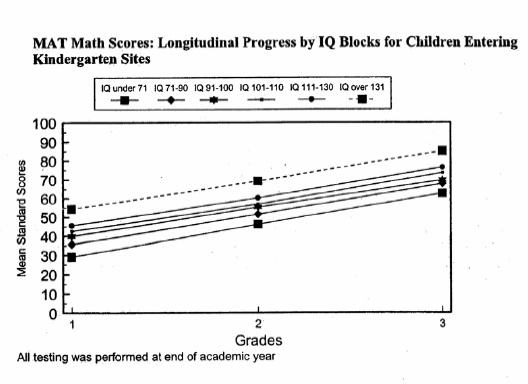
The achievement of all kids can be improved if we improve their instruction. In fact there's reason to believe that the achievement gap will, if anything, increase, with better instruction:
With more emphasis on the higher performers, their performance could have been accelerated more dramatically.It all comes back to IQ. On average, higher IQ kids will find a way to learn more if instruction is held constant. As a result, there will always be an achievement gap at least in the near future.
So what we have now is a short term transient situation which is the result of unequal educational improvement. We will eventually reach steady state again.
What Murray was really saying is that you can raise achievement (at least temporarily), but it's much more difficult to increase IQ. Eventually, the inability to change IQ will result in an achievement gap. The only way to eliminate the achievement gap is to mask it with "pass percentages, not mean scores."
I'm not vouching for the rest of Murray's argument, but this part he's gotten right.