August 16, 2007

A Fool's Errand

Is what I'm on.

I'm trying to track down what these "multiple measures" thingies are that Congressman Miller talked about in his speech.


In my bill, we will ask employers and colleges to come together as stakeholders with the states to jointly develop more rigorous standards that meet the demands of both. Many states have already started this process. We seek to build on and complement the leadership of our nation’s governors and provide them incentives to continue.

This requires that assessments be fully aligned with these new state standards and include multiple measures of success.

These measures can no longer reflect just basic skills and memorization. Rather, they must reflect critical thinking skills and the ability to apply knowledge to new and challenging contexts. These are the skills that today’s students will need to meet the complex demands of the American economy and society in a globalized world.

Sounded like edu-cant to me. So I decided to dig a little deeper.

As luck would have it, Sherman Dorn has a post on this topic in which he uncharacteristically uses a whole lotta words to say a whole lot of nothing in an apparent defense of "multiple measures" and a weak criticism of Ed Trust's attack of same. Nonetheless, Sherman has led me to the culprits behind this new meme--the Orwellian-named Forum of Educational Accountability who issued this 53 page "Expert Panel" Report (PDF), Assessment and Accountability for Improving Schools and Learning: Principles and Recommendations for Federal Law and State and Local Systems.I

Then I found this August 13th letter from a bunch of education "researchers" which draws from the above-mentioned report.

Are you still with me?

Good.

At 53 pages there's too much to comment on in a single blog post, so let's just pull down some low hanging fruit.

Here's a doozy from p. 40.

Gaps will only close if students who are behind progress more quickly than those who are not. There is a lack of evidence to demonstrate schools alone can ensure that their historically disadvantaged populations can progress more quickly than more advantaged populations. Expecting schools to accomplish this feat without markedly increased support is likely to continue the NCLB problem of causing harmful educational consequences resulting from educators' desperate attempts to meet NCLB mandates without the resources to do so.


Most of the "expert" panel are supposedly testing, assessment, and standards experts, yet they don't seem to know how simple statistics work.

It is not true that the achievement gap will only close "if students who are behind progress more quickly than those who are not." The gap can close if both groups progress at the same rate. In fact, the gap can also close if the group that is behind progresses at a marginally slower rate.

Perhaps an example is in order.


Let's suppose that we have two groups: the low performing group (the top distribution) and the high performing group (the bottom distribution). These groups have a mean difference in achievement of about a standard deviation. When we first test both groups the students perform at passing level 1. At this passing level, 50% of the low performing group is failing but only 16% of the high performing group is failing. This is represented by the shaded area under the curve The achievement gap is now 34 points (50 - 16).

Now let's teach the students and retest them. Let's assume that both groups improve by the same amount and now perform at passing level 2. At this passing level, 16% of the low performing group is failing, but now only 2% of the high performing group is failing. The achievement gap is now 14 points (16 - 2). The achievement gap has miraculously shrunk by 20 points. Since the distributions are normal, the area under the curve changes non-linearly.

Both groups have progressed at the same rate and yet the achievement gap has shrunk by more than half. In fact, the low performing group could progress at a substantially slower rate under this example and the achievement gap would still shrink. In this example even if the lower performing group only progressed to a level in between passing levels 1 and 2, let's say at a level where 35% of the students were passing, the achievement gap would still be shrinking even though the higher performing group progressed at a much faster rate.

This is statistics 101 and the "expert panel" who wrote this report should be ashamed of themselves for such misleading hackery.

Analyzing the first sentence, we've established that the "expert panel" doesn't understand simple statistics. Now let's establish that they also don't know anything about real education research by examining the second sentence.

There is a lack of evidence to demonstrate schools alone can ensure that their historically disadvantaged populations can progress more quickly than more advantaged populations.


Could it be that the "expert panel" has never heard of the largest and most expensive educational experiment in US history, Project Follow Through, in which one the interventions, the Direct Instruction Model, was able to get "historically disadvantaged populations" to progress more quickly than more advantaged populations? In fact, the Direct Instruction Model was able to get the "historically disadvantaged populations" caught up or nearly caught up to the more advantaged populations by the end of the third grade.


No, it couldn't be. Smart guys like these couldn't have missed something like that.

Ironically, by the time we get to the third sentence:


Expecting schools to accomplish this feat without markedly increased support is likely to continue the NCLB problem of causing harmful educational consequences resulting from educators' desperate attempts to meet NCLB mandates without the resources to do so.

we finally get something for which no empirical support exists.

There is no evidence that schools currently lack the resources needed to adequately educate disadvantaged children. Furthermore, there is no evidence that increasing resources will result in increased student achievement.

You'd be hard pressed to find a paragraph that is more wrong than this one, which is why I say I'm on a fool's errand analyzing this report.

August 14, 2007

Miller's Plan for Reforming NCLB

Last week I promised I would cover Congressman Miller's plan for reforming NCLB.

So here it is. Miller thinks he can improve NCLB by:

  1. Providing much-needed fairness and flexibility.
  2. Encouraging a rich and challenging learning environment and promote best practices and innovation taking place in schools throughout the country.
  3. Supporting teachers and principals.
  4. Continuing to hold schools accountable for students’ progress.
  5. Joining the effort to improve America’s high schools.
  6. Investing in our schools.

Let me translate this congressional gobbledygook into English:

  1. weakening standards
  2. spending more money
  3. spending more money
  4. doing more of the same
  5. spending more money
  6. spending a lot more money
So, Miller's main plan to salvage NCLB is to spend more money on education. That's always worked so wonderfully in the past, I can't imagine why it wouldn't work this time.

I suspect Miller thinks that he knows how to spend the money in new and better ways. Yet, I couldn't find any evidentiary support for anything Miller is proposing. I'm not surprised and neither should you be. Miller is one of the self-anointed educational experts who simply knows how schools must be run to achieve superior student achievement and doesn't find it necessary to justify any of his bold initiatives with cold hard evidence.

There's not enough digital ink to cover every one of Miller's points, so I'll hit the less silly ones.

The legislation I will introduce will contain a growth model that gives credit to states and schools for the progress that their students make over time.
Growth models are basically the same as the current safe harbor provision. There is the illusion of "fairness" since you are measuring the growth of the same cohort. But who are we kidding? The schools that need the growth model the most have such a high transient rate to make the concept of "same cohort" laughable. Moreover, there is a downward trend in student performance as they rise in grades, making achieving growth goals all but impossible, if the growth goals approximate anything close to the student's actually achieving proficiency by the time the graduate.

In addition, many Americans do not believe that the success of our students or our schools can be measured by one test administered on one day. I agree with them. This is not fair.
I suppose if "many Americans do not believe" it, it must not be true.

So what's the answer? More testing? Where is the evidence that more testing will yield more reliable/accurate results than one test?

We will allow the use of additional valid and reliable measures to assess student learning and school performance more fairly, comprehensively, and accurately. One such measure for high schools must be graduation rates.

So if they can't read or do math, the school passes if they graduate enough illiterate and innumerate students?

The legislation will also drive improvements in the quality and appropriateness of the tests used for accountability. This is especially important for English language learners and students with disabilities who should be given tests that are fair and appropriate, just as they should continue to be included in our accountability system.
Because the current legislation requires states to give unfair tests to ELLs and disabled kids currently. Actually the current legislation leaves it up to the states to decide and the states don't have a great interest in failing kids unnecessarily now does it?

In exchange for increased resources, states will be allowed to develop better tests that more accurately measure what all students have learned.
Sure it will.

In so many meetings I have had in my district and elsewhere, employers say that our high school graduates are not ready for the workplace.

Because states are looking to make their standards even tougher being that their students can't pass today's easy standards.

This requires that assessments be fully aligned with these new state standards and include multiple measures of success.

These measures can no longer reflect just basic skills and memorization. Rather, they must reflect critical thinking skills and the ability to apply knowledge to new and challenging contexts. These are the skills that today’s students will need to
meet the complex demands of the American economy and society in a globalized world.

We all know how well students apply those elusive "critical thinking skills" before they learn (or memorize if you will) those "basic skills."

This is pure semantics. The critical thinking skills kids learn today are tomorrow's basic skills, just as the basic skills kids learned yesterday form the basis of tomorrow's critical thinking skills. Skills are skills are skills.

Even with all of these changes, we will not meet our national goal of closing the achievement gap until and unless we close the teacher quality gap. No factor matters more to a children’s educational success than the quality of their teachers and principals.

Except the curriculum factor. Great teachers with a substandard curriculum aren't exactly known for their superior results.

All children deserve their fair share of teacher talent and expertise. We must do more to ensure that poor and minority students are taught by teachers with expertise in the subjects they are teaching.

In a world where the rules of supply and demand do not exist perhaps.

As a nation we are not offering teachers the respect and support they deserve today, and as a result we are facing a very real teacher shortage crisis. Particularly in urban and rural communities, in subjects like math, science, foreign language, and for children with disabilities and children learning English, we must hire, train, and retain excellent teachers.

For these reasons, the legislation I will introduce will provide for performance pay for principals and teachers based on fair and proven models, teacher mentoring, teacher career ladders, and improved working conditions.

A certified teacher shortage perhaps. But there is no shortage of
people capable of educating students in any of these subjects. This one will get past the teachers unions sometime about the time hell freezes over.

The bill will include comprehensive steps to turn around low-performing middle and high schools. It will include uniform standards for measuring graduation rates that are fair, accurate, reliable, and will do more to keep students in school.

Because we know exactly how "to turn around low-performing middle and high schools." Thankfully, those "steps" will be enshrined in the next legislation.

This new direction for education in America is premised on the growing consensus that there is a need for greater and sustained investments needed in American education.
...

The legacy of a great American education system for our children and our country cannot be built on the cheap. America deserves better.

"Growing consensus" my ass.

If only our education system was built on the cheap.

Social and economic opportunity begins in the classroom. Discovery and innovation begin in the classroom. Economic growth and economic disparity begin in the classroom.

This is all true which is why our public education system with all its unfulfilled promises for minorities and the poor is such a national disgrace. It is a failed experiment with socialism. Miller merely wants to double down now, like a good tax and spend Democrat that he is, when he should be folding his hand.

It's Being Done

A few posts back, I lambasted journalist-turned-author, Linda Perlstein, for her hackneyed observations made during a year long visit to one cherry-picked elementary school.

Perlstein is one of the anointed. She doesn't seem to understand that when you observe a correlation between A and B, this might mean that:


  1. A causes B

  2. B causes A

  3. Both A and B are the results of C or some other combination of factors

  4. It is a coincidence.

The anointed stop the analysis at the first or second pattern of causation and don't worry too much about the last two, even though typically in education the evidence is rarely sufficient to conclude that the result is anything more than a coincidence.

But enough about Perlstein.

In the comments, another journalist-turned-author, Karin Chenoweth, left the following comment:


[F]or those readers interested in a book that demonstrates how successful high-poverty and high-minority schools operate, I would suggest they read my book, It's Being Done: Academic Success in Unexpected Schools.

The criteria I used to select schools to visit are fairly clear--the schools had to have substantial populations of students of color or students of poverty or both, and high achievement scores or rapid improvement trajectories. (The criteria are laid out in more detail in chapter one.)

For the most part, these schools did not spend endless amounts of time having students writing paragraphs about poems nor writing endless numbers of poems, but rather taught them some poetry, along with lots of other literature, science, history, and other stuff. In other words, they honest-to-goodness taught their students.

The book was published by Harvard Education Press. Learn more about it at http://www.hepg.org/hep/Book/65.

I realize this is a shameless plug, but it seems appropriate to the discussion.

An interview with Chenoweth can be found here. And, the criteria she used to select the schools she observed are:

  1. Significant population of children living in poverty and/or a significant population of children of color

  2. Proficiency rates above 80 percent, or a very rapid improvement trajectory

  3. Smaller achievement gaps than the state

  4. Two year’s worth of comparable data

  5. High graduation rates and high proportion of freshmen who are seniors four years later (Promoting Power Index)

  6. Annual Yearly Progress met

  7. Open enrollment for neighborhood children (no magnet, charter, or exam schools)

You cheapskates can find many of the articles that form the basis of the book here.

Chenoworth's interview is much better than Perlstein's. She appears to understand what is important to improve student achievement and what is not:

I think some of the structural reforms that people focus on are not all that important. For example, the grade configurations of schools. Whether a school is K–8 or broken up into elementary and middle school is not as important as making sure that teachers know what needs to be taught at each grade level. Similarly, whether a school has a block schedule or a six- or seven-period day is less important than the quality of instruction. At a district level, whether a school board is appointed or elected is not as important as whether the district has a coherent curriculum and a [teacher] development plan that supports the curriculum.

It is about improved instruction and making sure that the instruction is working. To do that you need strong leadership and data. You get data by testing. And, the strong leadership makes sure that the right course is taken in response to the data.

And, that's what came through when I read the Achieve Alliance articles Chenoworth penned.

However, what also came through was that many of these "successful" schools were still making it up as they went along. Which is to say that their decisions were not fully based on the current state of education research. These schools have made many right decisions, but they've also made many ineffective decisions--decisions that the leaders of these schools should have known were not the best decisions to take.

And, the articles, and I suspect the book as well, does not provide the level of detail necessary to inform other school leaders how to change their own schools to achieve similar results. Moreover, what we get are a bunch of "one-off" success stories, whereas it would have been better to have gotten replicated success stories so we can discount the possibility that the results are due to coincidence.

Then there is the problem that what the schools think is the cause of their success and what Chenoworth thinks is the cause may not in fact be the real cause. I don't see the track record of success from anyone that would lead me to trust their opinion. Nonetheless, there is value in dispelling the myth that schools are responding to NCLB by turning themselves into test prep factories and by limiting the curriculum.

Take a look at one school that Chenoworth visited--Stanton Elementary School in Philadelphia. Here's the report (pdf). I noticed this potential problem.

In the 2003-04 school year the scores skyrocketed when 71 percent of Stanton’s students met state reading standards and 47 percent met state math standards. The growth was so dramatic, in fact, that the district retested the students to
make sure there had been no mistake or chicanery. The retest confirmed that most students at Stanton were meeting state standards in reading, and many exceeded those standards. And when the 2005 test scores were released, showing that 73
percent of the students met state reading standards and 84 percent met state math standards, it was clear that 2004 had not been a one-year fluke but rather a reflection of new practices – practices that include a careful reorganization
of instruction, comprehensive professional development of teachers, close examination of student data, a curriculum tightly aligned to state standards, and shrewd use of federal Title I dollars.

Based on the data from SchoolMatters and despite the re-test, I am suspicious of these fifth grade scores. Stanton did indeed perform well, above the state average, in fifth grade in 2006. But, Stanton also performed below average in every other grade tested, i.e., third, fourth, and sixth, in 2006. I am especially suspicious of the anomaly in the reading scores. The cohort that had 73% passing in 2005 (fifth grade) sunk down to 16% passing in 2006 (sixth grade). Such a dramatic decline should be all but impossible if the student achievement was the result of a real educational improvement as opposed to artificial test prep. The decline in math was nearly as dramatic.

The fifth grade test has been around for a long time. The fourth and sixth grade tests are new. I have a feeling there was more test prep going on that Chenoworth observed on the two days she visited.

The Vision of the Anointed

During my vacation weekend I read The Vision of The Anointed by economist Thomas Sowell.

It's not directly about education.

But, it's all about education, if you know what I mean.

Education is full of the self-anointed elite, and their numerous followers, who make education policy and whose prevailing social vision is "dangerously close to sealing itself off from any discordant feedback from reality." Hence, the hatred of testing and NCLB which mandates such testing.

It's not so much that their views are especially evil or especially erroneous (though they certainly are erroneous). The problem is that the ignoring or evidence and feedback permits the blind following of a dangerous course of action to a fatal conclusion until you wind up with a majority of students who can neither read nor perform basic calculations at an acceptable level of proficiency.

Sowell explains the danger of this mindset:

Even when issues of public policy are discussed in the outward form of an argument, often the conclusions reached are predetermined by the assumptions and definitions inherent in a particular vision of social processes... To a remarkable extent, however, empirical evidence is neither sought beforehand nor consulted after a policy has been instituted. Facts may be marshaled for a position already taken, but that is very different from systematically testing opposing theories by evidence. Momentous questions are dealt with essentially as conflicts of visions.

Sound familiar? Or, how about:

The focus here will be on one prevailing vision--the vision prevailing among the intellectual and political elite of our time. What is important about that vision are not only its particular assumptions and their corollaries, but also the fact that it is the prevailing vision--which means that its assumptions are so much taken for granted by so many people, including so-called "thinking people," that neither those assumptions nor their corollaries are generally confronted with demands for empirical evidence. Indeed, empirical evidence itself may be viewed as suspect, insofar as it is inconsistent with that vision.

Lots of good stuff which will make for good blog fodder for months to come. In the meantime, go pick up a copy and read it.

Once you understand how the anointed think, its much easier to dissect their "visions."

Back from Vacation

Took the family to Cape May, NJ for a little vacation.

We stayed at the Inn of Cape May, a 113 year old Victorian Inn.


Because we made reservations so late, we got stuck in the fancy (i.e., more expensive) room all the way up on the tippy top (the fifth floor). Normally, this is a bonus, but the Inn lacks a full time elevator which means walking five flights of stairs--Victorian Style.

The inn is very charming in a late 19th century sort of way. All weekend long I wanted to don (and then doff) a monocle, wax my moustache (and grow one), and go on at length about the Union and Pacific Railroad. The Inn has been updated with many, but not all, modern amenities, such as electricity, private baths showers, and air conditioning.

The renovations are, shall we say, less than perfect. The A/C unit is guaranteed to wake the dead as it cycled through its refrigeration cycle, though it did manage to keep the room cool. The retrofitted private bathroom was tiny and made a small room feel even smaller. The old public bathrooms (at the end of the hall at each floor) are still there as a ghostly reminder of less affluent times. And the electricity was added the cheap way - by running conduit on the outside of the walls. Even then the electric outlets were few and far between.

Nonetheless, it's nice to see how bad the "rich" had it 100 years ago. No one would mistake the pre-renovated Inn for squalor, though the lack of bathrooms and electricity would certainly cause modern day poverty hustlers to agitate for better living conditions. We don't realize how good we have it today.

We also took the kids on the obligatory trip to the Wildwood boardwalk one night. Bit of a let down after visiting DisneyWorld last year, especially considering it was just as expensive.

The Northeast elites are fond of disparaging middle America as being unsophisticated. They need to visit their own amusement parks before casting such aspersions. I saw lots of tattoos, piercings, obesity, and bad manners, not to mention expensive cell phones, clothing, hair styles, and sneakers among the boardwalkers. Poverty is not what ills these people.

And, don't get me started on the nanny state hi-jinks that is New Jersey.

August 10, 2007

No Child labels schools unfairly, administrators say

As NCLB reauthorization approaches expect to see a lot more thinly veiled articles like this one from the San Diego Union Tribune trying to water down NCLB.

The premise is given in the lede:

The federal accountability system for public schools unfairly labels many achieving schools as failures, regional school leaders said yesterday.

Let's see if the "reporter" has marshaled any facts to support the premise that NCLB is unfairly labeling "many achieving schools as failures." Notice the careful., i.e., misleading wording.

First, we get the obligatory grudging acceptance from educators:

“We understand (No Child left Behind) is here to stay, but it needs to be fixed in order to be reauthorized,” said Kelli Moors, board president for the Carlsbad Unified School District.

They tried for six years to get NCLB repealed. That failed due to overwhelming public support. Their new tactic is attempt a flanking maneuver during reauthorization to water down the law so they can go back to miseducating kids without the pernicious spotlight of shame shining on them.

Next, we get a rhetorical alley oop from the reporter who cites misleading facts:

The No Child Left Behind Act requires that all students achieve the same minimum pass rates on state academic exams. By 2014, all students must reach at least “proficient” levels of performance on state exams.
By 2014 "all" students are not required to reach the "proficient level. Presently 1% are permitted to talk an alternate assessment that is in accordance with their needs. Severely retarded students do not have to pass the same test given to regular-ed students.

Then we get the only evidence cited to support the premise:

Many public school administrators, board members and teachers say the federal system, unlike the state accountability system in California, fails to recognize school progress over time. No Child Left Behind, they say, unfairly labels many schools as failures – no matter how much they are improving from year to year, or how close they are to meeting federal benchmarks.

NCLB does in fact recognize progress. NCLB contains a Safe Harbor provision that permits a school that is, in fact, failing to avoid the "failing label" if it reduces its percentage of students not meeting standards by 10% of the previous year's percentage.

I fail to see how this is unfair. If you are not meeting your state's pass rate and aren't improving sufficiently to fall within the safe harbor, you are failing regardless if you miss that mark by 30% or 0.01%. This isn't horseshoes or hand grenades. Near misses don't count.

So to sum up: NCLB does, in fact, recognize "school progress over time."

Check out this Ed Sector report for the full story. In fact, you'll want to bookmark that report for ready reference because you're going to be seeing a lot more articles like this one in which the reporter doesn't understand the provisions of NCLB relating to Adequate Yearly Progress and educators are all too willing to bamboozle him/her to further their agenda.

August 9, 2007

Nitwit author makes nitwit observations

In USA Today, Greg Toppo interviews Linda Perlstein, a former Washington Post reporter, who spent a year at Tyler Heights Elementary School, a "high poverty elementary school in Annapolis, Md" to see for herself the effects NCLB was having on failing schools.

She even wrote a book about it.

Based on this interview, Perlstein clearly didn't know the first thing about education going into the project and failed to learn anything useful during the project. Perlstein bemoans the neglect of "science experiments" in the curriculum, but it is evident that she has never learned how to conduct her own scientific experiment. Her year at Tyler Heights was one big failed experiment from the get go.

To wit: Hotshot reporter observes one failing school. Said failing school makes changes in response to NCLB's requirement to improve student achievement. Said changes fail to achieve desired improvement. Failed educators give hot shot reporter their "opinion" as to why the improvements failed to work and/or how they believe improvements can/should be made. Hot shot reporter adopts opinions uncritically thinking she's learned something.

She hasn't.

All Perlstein has learned is that she picked the wrong school. You don't learn anything from a failed experiment (except, of course, that that that's one way not to do things). There are an infinite number of responses that educators can make in an attempt to improve outcomes. The vast majority of those responses will fail to achieve improved outcomes. Existing evidence shows that only a precious few responses will achieve real gains in student achievement. Had Perlstein been fortunate enough to pick one of these successful schools, she might have learned something useful. Instead, she only learned about one way (albeit a very popular way) a school could get things wrong. And, instead of cutting her losses and writing off a wasted year, she wrote her book anyway and filled it with her own uninformed opinions and the opinions of those who have never failed to raise the achievement of students like the students found at Tyler Heights.

Let's examine what Perlstein thinks she learned from her year at Tyler Heights.


I don't have a problem with testing children. I have a problem with thinking test results tell you most of what you need to know. They simply don't — these tests are often very narrow instruments.

Clearly, Perlstein isn't a psychometrician and hasn't talked to one during her investigation. Of course, there's a lot more to education than learning how to read and do basic math. But, if a student hasn't learned how to read and do basic math, it's fair to conclude that the student is dead, educationally speaking, and that the school has failed at this first critical educational step. I've never seen a student who magically compensated for not knowing how to read and do basic math by learning an adequate amount of history, science, geography, algebra, etc. Such a beast does not exist and never has.


Where reforms have forced educators to notice children who might otherwise have been neglected, I give credit. But I wrote this book because school reforms intended to abolish a two-class system were in some ways exacerbating it. There's one world where students pass the test as a matter of course and get to write poems, and another where children write paragraphs about poems.

Meanwhile, there's supposed to be a movement in American schools to educate each child as an individual. The teachers at Tyler Heights work mightily to do that, but they have to get everybody to the same place in the same amount of time, and follow daily curriculum agendas handed down from above.


You know, I just can't place my finger on the section of NCLB that requires schools to force students to "write paragraphs about poems" instead of "writ[ing] poems." That's because such a rwequirement doesn't exist.

Perlstein is failing to distinguish between a problem with NCLB and a problem that some educator has made is response to NCLB's requirement that students actually learn how to read and do basic math. Some wacky educator in Maryland decided that "writ[ing] paragraphs about poems" was a good way to become proficient at passing some portion of the reading test. As it turns out, that's not a good way to teach. Time to change to something that does. (And, let's not ignore what Perlstein has likely failed to observe since it ended before she got to Tyler: disadvantaged students "writing poems" like the advantaged kids and still failing to learn like the advantaged kids.)

Meanwhile, there's supposed to be a movement in American schools to educate each child as an individual. The teachers at Tyler Heights work mightily to do that, but they have to get everybody to the same place in the same amount of time, and follow daily curriculum agendas handed down from above.

First, teachers don't make policy decisions. Policy decisions get handed down from above. Just like the curriculum. As long as teachers do as they are told or do what they are permitted to do, there are no repercussions for them when students fail to learn. That responsibility goes to the higher-ups (who frequently try to pass the back down).

Second, the movement to "educate each child as an individual" has failed to produce demonstrable results, so that's a red herring.

Third, there is no requirement to get "everybody to the same place in the same amount of time." NCLB's requirement is to get everyone past a certain point by a maximum amount of time; for example, all students must be reading on at least a third grade level by April of third grade. Implicit in that decision is a policy choice that students can be (and should be) taught to read on what is nominally a third grade level within 3-4 years of schooling.

Tyler Heights kids in some ways are very fortunate: Even though many are poor, their well-off district provides them a safe, clean building, plenty of learning tools and a smart, hard-working staff who cares immensely about them.

Somebody call Jonathan Kozol and tell him we've found the counter example that disproves his life's work.


But those educators feel constrained because of rigid curriculum strictures, the low skills of many kids and the pressure to excel on the test.

I love the words Perlstein has chosen to obfuscate the issue. Instead of saying "pressure to excel on the test" she could have more accurately said "pressure to teach students so that they learn what they are expect to learn and which will be confirmed by their ability to pass a simple multiple choice test." But I suspect that isn't anti-test enough for her agenda.

I also like the conceit that educators are "constrained" and that if they weren't so "constrained," by NCLB of course, they would do wonderful things and perform miracles with these children. Problem is that making collages in ed school and learning wacky educational "theories" doesn't adequately prepare teachers to actually induce learning in students who won't learn on their own. When most teachers are given the freedom to innovate instruction, we still get just as much failure as we do when they are constrained. The only difference is that we get different kinds of failure. That is the sad reality. There are a very few exceptions to this rule and it has nothing to do with whether teachers are constrained or not. It only matters that they teach in a way that works, which few of them know how to do on their own.

So a teacher suspects her third-graders might be asked on the test to write a paragraph enumerating the elements of a poem. The kids can't get it right. Does she have them write that paragraph over and over until they do, or does she let them actually write poems? The latter would be more engaging and, in the long run, instructive, but the school might calculate that drilling is the more direct, reliable line between two points.

Here we go again with the poem writing, like that's the only problem these kids have. Many of these kids can't read anything approaching their grade level, let along a poem. And don't ask them to spell, write a coherent paragraph, analyze what they've read, subtract multi-digit numbers, or calculate the area or triangle, to name but a tiny fraction (and don't ask them to manipulate fractions either) of their deficiencies.

And, what's up with "The kids can't get it right"? Isn't it more accurate to say "The kids can't get it right after the teacher has tried to teach them." This phrasing implies a solution that the original does not, i.e., teach better.

Or what about this false dilemma: "Does she have them write that paragraph over and over until they do, or does she let them actually write poems?" Because there is not third alternative. A third alternative would be very helpful in this situation since alternatives one and two don't seem to work very well. But, Perlstein doesn't realize that a third alternative exists because she never observed a school that successfully employed an alternative.

And, I'm wondering how Perlstein knows that "writing poems" is "more engaging and, in the long run, instructive" for these kids since there is no evidence, except Perlstein's conclusory opinion that it is. Perhaps for advantaged kids it is. But, that doesn't mean that you can extrapolate that solution to disadvantaged kids since these kids apparently have unremedied deficits that preclude them from performing at this high level.

Or that science experiments, since they won't be on the test, aren't the best use of a too-short school day. These aren't choices I agree with, but I understand why they're made. The schools with rich curricula exist here and there, most likely with daring staffs and flexible school districts that give
educators plenty of room to innovate.

Why do we care what choices Perlstein "agrees with"? It's not like she's successfully taught disadvantaged kids or has talked to anyone that has (there don't appear to be any at Tyler Heights).

And who is to say that a so-called "rich curricula" (whatever that is) is the right answer? I suspect she thinks that a rich curricula is what rich kids, like her, received at their fancy suburban school. If it worked with her, it must also work for the poor kids. Right? See: busing, failure thereof.

Then Perlstein gives us the example of a teacher trying to teach to the Nonsense Word Fluency Test by directly teaching nonsense words.

The teacher wanted her kindergartners to be prepared for their assessment, which makes sense. Kids should learn to sound out letter combinations whether or not they make actual words. But she would have preferred to use that time teaching her kids real vocabulary.

Clearly, the teacher was trying to cheat by coaching the kids on the nonsense words that would be on the test. That kinda defeats the purpose of the test which is trying to see if students have adequately learned phonics skills (which even the whole language nutters now think is important) for words they've never seen before and which can only be read if you know phonics.

The problem here is that the teacher isn't able to get the kids to learn how to read with any degree of proficiency. So, the next best thing is that they pass the assessment. And the easiest way to do that, at least in the short run, is to try to game the test. That's the problem: the inability to teach, not the assessment. The assessment merely shows that learning has not occurred and that the teaching has failed.


After I left Tyler Heights, the principal eased up a bit on her "laser-sharp focus." Activities were spread more evenly throughout the year, third-graders wrote poems, there were more attempts at critical thinking. Compared to the previous year, the percentage of kids passing the state test decreased in more categories than it increased. But I don't think the teachers would tell you the students learned any less.

That's the beauty of NCLB. Here we have a failing school that changed how it taught, but did so in way that wasn't effective. Hopefully, next year it will change to something different (and that probably won't work either).

Without NCLB, we wouldn't know these failings of Tyler Heights and schools like it. Now we do. And, that's a good thing. One could argue that if the tests were low stakes, we'd still know about the failings of Tyler Heights. This is true. But the difference is that if the tests were low stakes, Tyler Heights wouldn't care and wouldn't be trying to change its failing ways. Now they are. And that also is a good thing, even though it might be a long time before it stumbles upon the right solution. That's another problem; Tyler Height's educators learn about as slowly as their students. Too bad Perlstein was paying the educators undeserved deference too see this for herself.

U.S. News consults wrong critic

It's the 50th birthday for Dr. Seuss' The Cat in the Hat. So U.S. News and World Report is running the obligatory puff piece commemorating the anniversary. In paragraph three we learn this little tidbit.

236 words. Geisel had been publishing children's books for 20 years when Cat was published in March 1957; early titles included the classic Horton Hears a Who! The particular endurance of Cat, many critics say, is owed partly to its origins in an emerging philosophy of phonetic learning. Most of the 236 individual words in the book were taken from a list of beginner words for new readers, and only a few are more than one syllable.

So much for U.S. New's vaunted editorial oversight. The Cat in the Hat is about as anti-phonics as you can get. The Cat in the Hat was written as part of the failed "Look Say" movement, the predecessor of the failed (but unfortunately still existing) whole language movement, which required students to memorize words instead of learning the phonetic code.

Dr. Seuss responded to this “challenge” by rigidly limiting himself to a small set of words from an elementary school vocabulary list, then crafted a story based upon two of the words which rhymed—cat and hat.


Dr. Seuss' books were created to supplement the 'look say' reading programs taught in schools. Dr. Seuss' publisher supplied him with a sight vocabulary of 223 words which he was to use to write his books, a sight vocabulary that was in
harmony with the sight words the child would be learning in school.

In an interview he gave in Arizona magazine in June 1981 Dr. Seuss claimed the book took nine months to complete due to the difficulty in writing a book from the 223 selected words. He
continued to explain that the title for the book came from his desire to have the title rhyme and the first two suitable rhyming words that he could find from the list were 'cat' and 'hat'. Dr. Seuss also regretted the association of his book and the 'look say' reading method adopted during the Dewey revolt in the 1920s. He expressed the opinion that "[...]killing phonics was one of the greatest causes of illiteracy in the country."


I think some of U.S. New's editors must have learned to read using "Look-Say."

August 8, 2007

Miller's Speech Continued

Let's take a look at the second part of Miller's speech: the part where he gives us his learned suggestions for improving NCLB.

Throughout our schools and communities, the American people have a very strong sense that the No Child Left Behind Act is not fair. That it is not flexible. And that it is not funded.

And they are not wrong.

...

We want a bill that is fair and flexible – that maintains the integrity of the law through accountability while responding to the legitimate concerns that have been raised.


What a lame rhetorical device that "the American people have a very strong sense" line is. Notice how it allows Miller to weasel out of giving us his opinion and taking a strong position. Political hackery at its finest.

Is NCLB not fair? NCLB permits states to create their own assessment devices, their own standards, their own passing cut scores, and their own definition of AYP. To the extent that the results aren't fair, much of the blame can be laid at the feet of the states.

Is it not flexible? Hello, safe harbor provisions. And, do we really want schools to have the flexibility to excuse the performance of the difficult to educate? That's why NCLB exists in the first place. Schools are all too willing to excuse performance and create phony "disabilities" to excuse their inability to educate.

Is it not funded? The only additional requirement NCLB added was the assessment provisions. Those are fully funded and then some. the predecessor to the NCLB already doled out plenty of free funding to schools. That funding continued. The only difference was that schools would have to achieve demonstrable results under NCLB. The chickens have come home to roost.

Let's see what Miller has to say.

I have always said that I am proud to be one of the original coauthors of the No Child Left Behind Act. But what I really want is to be the proud coauthor of a law that works.

To that end, for the last five years I have traveled this country listening to teachers, administrators, students, parents, governors and many others about how the law can be improved. I have listened carefully, as have my colleagues. We have heard an emerging consensus about needed changes.


An emerging consensus? There used to be an "emerging consensus" that the earth was flat, that bleeding was an appropriate medical treatment, and that the sun revolved around the earth. In each of those instances, the "emerging consensus" proved to be wrong because the "experts"doing the consenting relied upon their uninformed opinion. rather than on solid science.

Think global warming. There is "consensus" in the absence of hard science. The "consensus" is all but worthless, especially when you consider that the "science" underlying that "consensus" can't accurately predict the weather next week, let alone a century from now.

Same deal with education. Those doing the consenting have never reliably educated the difficult to educate children NCLB is concerned with, have never reliably induced learning in these children, and have no "science" informing their opinion. Plus, they have a vested interest in avoiding the requirements imposed by NCLB since they are the ones under its yoke.

Miller is, of course, pandering to the special interest groups behind this "emerging consensus" pure and simple.

My vision for this next bill is to take America’s education policy in a new direction by doing six key things:

  • Provide much-needed fairness and flexibility.
  • Encourage a rich and challenging learning environment and promote best practices and innovation taking place in schools throughout the country.
  • Support teachers and principals.
  • Continue to hold schools accountable for students’ progress.
  • Join the effort to improve America’s high schools.
  • Invest in our schools.

Exactly the sort of vague non-specific recommendations that have failed to achieve results in the past. We'll cover each point in the next post.

August 7, 2007

Chairman Miller Remarks on the Future of the No Child Left Behind Education Law

Last week Congressman George Miller, chairman of the House Education and Labor Committee, gave a speech to the National Press Club on the future of the No Child Left Behind law.

Supposedly, it was an important speech because Miller fancies himself as an important guy whose agenda includes education. Let's see if he knows what he knows what he's talking about.

Over 40 years ago, President John F. Kennedy had a vision of sending a man to the moon and bringing him home again.

That vision fueled a massive investment by this nation in all levels of education – an investment that drove nearly four decades of discovery, innovation and economic growth, allowing America to have the world’s strongest economy and lead the community of nations for generations.

Sadly, this investment fell off over the years.


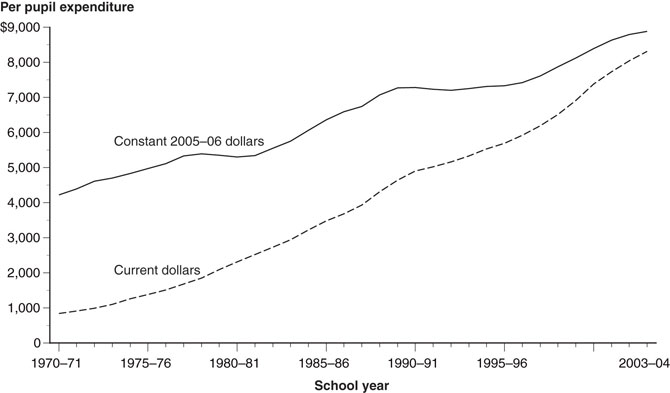
There we go. It only took three paragraphs for Miller to get his facts wrong. "Investment" in education has not fallen off over the years. If anything, it's grown dramatically.


And, the Fed's portion of that "investment" has pretty much remained constant at about 10%.


I suppose Miller never heard of this thing called the Internet where anyone can find out that he's( a) lying to us, (b) doesn't know what he's talking about or (c) both. My money's on (c).

(BTW I'm giving him a pass on "an investment that drove nearly four decades of discovery, innovation and economic growth" since we can't disprove the causation that Miller's suggesting, though the objective measures of improvement implicitly reject the theory that all this money thrown into education has gained anything.)

With the report A Nation at Risk, America woke up and saw an education system that no longer served all its children and was failing our future.

There is little dispute that our public education system continues to "fail[] our future;" but, I take issue with the statement that our "education system ... no longer served all its children." This implies that at one time our education did serve the needs of "all its children." It never did. There never was a golden age of public education in this country (or an other). The lofty goal of public education have never been realized. Ever. Anywhere.

Then he gives us a couple of paragraphs of blustery flapdoodle about the motives behind NCLB, what lawmakers thought it could accomplish, and the supposed gains we've made since the law was enacted. Those gains are based on shaky standards and are mostly illusory at this point. But when Miller says:

The law is shining a bright light on the achievement gaps among different groups of students in the U.S. and among the states. Now – for the first time – we know exactly which students, and which groups of students, are not learning and performing at grade level. This information makes it impossible for us to ignore those students who are not succeeding.

And finally, the law has provoked an energetic national debate about our nation’s system of public education and the need for the next generation of investment in our schools, students, principals and teachers. That is a good thing.


I find it hard to disagree. If NCLB has achieved anything it certainly has made the many failings of our education system more transparent and has shown us "exactly which students, and which groups of students, are not learning and performing at grade level." And, as this embarrassing data has come to light, it has certainly sparked debate since the public now knows that those in charge of providing a quality education to our children have been failing miserably at the task. Unfortunately, the debate has largely been about the opponents of NCLB trying to do away with or water down NCLB so this data could be more easily suppressed rather than improving education outcomes under NCLB. Pity that.

Even more unfortunately Miller appears to be succumbing to this mentality. He spends the rest of the speech trying to come off as a champion for NCLB will systematically offering revisions that would undermine the efficacy of NCLB.

We'll cover Miller's proposals in part II.

July 24, 2007

New lows reached

Here we go again:

Jonathan, 10, and Ankur, 11, were among about 85 students from Jefferson and surrounding counties who participated in this year's Pepsi Summer Portfolio Institute at the University of Louisville last week.

The institute, which began about 13 years ago, is a place where students entering grades four through eight and teachers of elementary through high school classes creatively combine math and writing skills, often using technology that would intimidate the average adult.


The tech might, but I bet the math won't. Assuming there is any math, which there probably isn't.

In other classrooms, students and teachers used graphing calculators to visualize what happens as they time a bouncing ball, employed animation programs and storyboards to create Claymation movies, and used computers to work out story maps before composing reflective writing assignments.

Chanel Acklin, 9, hasn't started fourth grade at Jeffersontown Elementary yet, but she already knows how to use PowerPoint because of the institute. Her group took up-close photographs of themselves, combined them in a slideshow and had other students guess which photo was of which student, she said.

"That was pretty fun, but using the calculators is pretty hard because sometimes I forget things," Chanel said. "I'm glad I can do this though, because I'm pretty nervous about fourth grade and maybe since I've done it a little now, it won't be so bad."


See? No math. Just graphic calculators. And, the kids can't remember enough math to use them properly.

July 23, 2007

The WaPo Editors are Idiots

In an editorial promoting the use of discrimination to achieve racial and socio-economic balancing in school districts the WaPo editorial board make the following highly irresponsible statement:

And the evidence is strong that low-income students thrive in higher-income schools -- in fact, after the socioeconomic status of a student's family, the biggest predictor of academic success is the socioeconomic level of the school. In the 2005 National Assessment of Educational Progress given to fourth-graders in math, low-income students attending more affluent schools scored 20 points higher -- the equivalent of almost two years' learning -- than low-income students in high-poverty schools. Low-income students in middle-class schools did better than middle-class students in high-poverty schools.

First, "thrive" is a poor choice of words. Low-income students do not thrive in higher-income schools. The fact is that they fail in unconscionably large numbers even in higher-income schools.

Second, there aren't enough higher-income schools to place all the poor kids into so that the "magic aura" of the rich kids can rub off on the poor kids and magically boost their performance.

And third, the classification of low -income for purposes of NAEP includes income levels up to something like $40,000 which includes kids who are decidedly not all that poor. The WaPo editors also don't seem to realize that the poor kids in the higher-income schools aren't as poor on average as the kids in the poor schools. It is this differential that is attributable the tiny 20 point difference the WaPo Editors allegedly found in 4th grade NAEP math scores.

It is this kind of misreading of data which leads to silly education policies like that propounded by the WaPo editors. It's not like we don't have decades of busing data showing that this kind of racial balancing doesn't lead to increased achievement.

July 18, 2007

A plan for failure

I'm sure the Civil Rights Coalition for the 21st Century means well, but the executive summary of their latest report, A Plan for Success: Communities of Color Define Policy Priorities for High School Reform (pdf), makes it clear that they don't know the first thing about education and why minority students underperform.

The report is long on lofty goals and short on credible ideas how to achieve those goals.

The coalition's main plan is -- wait for it -- that schools serving minority populations need more funding because they are underfunded.

Why are there such blatant inequities in the distribution of education opportunities in America? One key problem is that many high-poverty schools, which predominately serve students of color, lack the funding and resources of wealthier schools and districts. A recent report noted that in thirty-one of forty-nine states studied, school districts with the highest minority enrollments received fewer resources than districts with the lowest number of minorities enrolled (Carey 2004). Another study determined that in schools where at least 75 percent of the students were low-income, there were three times as many uncertified or out-of-field teachers teaching English and science than there were in wealthier schools (Wirt et al. 2004).

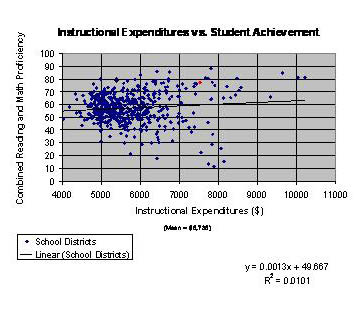
Last I checked, warmed-over Marxism does not have a long history of success, yet it always seems to get trotted out front and center by organizations like this. However, that's not the main fault of this suggestion. The main fault is that it is almost categorically untrue that schools that serve minority populations have less funding than the average school district. Schools that serve high minority populations are typically found in big cities and big city schools are some of the most well-funded schools in the state. About the only schools that are funded better than big city schools are schools in the wealthiest of suburbs. This is a red herring, because there is no correlation between instructional spending and student achievement. Here's a plot of those variables for Pennsylvania's 501 school districts.

Notice how R2 is 0.0101. That indicates that the correlation is random. The scatter plot shows that pretty clearly when instructional expenditures are between $4000 and $7000. Then we see a somewhat odd phenomenon when instructional expenditures are over $7000, representing funding at about the 95th percentile. At this high level of funding you see two distinct trends.

The first is an offshoot of highly funded schools that perform above the regression line. These are your wealthy suburban school districts. The second offshoot is the highly funded schools that perform below the regression line. These are your big city schools. Notice how increased funding has not resulted in superior academic performance for these schools at all.

Increased funding is not the answer to the woes of schools serving minority and low-income populations.

The report also suggests that academic achievement can be increased by attracting better teachers. That's problematic as well and I'll save that discussion for a future post.

The report also lists a bunch of vague bromides, lacking specifics and any indicia that enacting such bromides have been successful in the past. But that's pretty much it. More money and non-specific bromides are the answer to our education woes. Why do these organizations even bother?

July 17, 2007

The Freep doesn't get it

The Detroit Free Press has a typically silly editorial today on education and the plight of minorities who tend to drop out of school in disproportionate numbers.

If you could take a class photo of the 1.2 million young people who drop out of high school in this country each year, one detail would be obvious -- and troubling.

Students of color, usually poor, dominate. It's true in Detroit, where one recent report estimates that city schools graduate only 24.9 % of students who start 9th grade, and shows up in every major study of the dropout population. Failure to complete high school is an epidemic problem among poor minorities, the population that's most in need of education to escape poverty.


Actually, not completing high school is an epidemic problem among poor white students as well. More accurately not completing high school is a problem for all students who don't have the cognitive ability to master academic material on the K-12 level as it is currently taught, i.e., poorly.

The sad truth is that you have to be smart to do well enough academically to graduate high school. That's the way it's always been.

Brett over at DeHavilland Blog has an excellent post on Thomas Jefferson's views on education and his thoughts on student ability at the turn of the 19th century:

2) Every child is entitled to three years of instruction in reading, writing, and arithmetic.

...

5) Students at grammar schools study "Greek, Latin, geography, and the higher branches of numerical arithmetic."

6) After a trial period of one or two years, the best student at each grammar school is selected for six years of further instruction. "By this means . . . the best geniusses will be raked from the rubbish annually, and be instructed, at the public expense, so far as the grammar schools go."

200 years ago, the state of education was such that only a tiny fraction of students (the geniuses) had the cognitive ability to acquire a high school by the then-current pedagogical means.

By and large pedagogical techniques haven't improved since then. You still need to be pretty smart to acquire the watered down academics that pass for a k-12 education today.

Education continues to be brutally discriminatory against the dumb.

If you want to increase the percentage of kids that graduate high school, the simple answer is to improve teaching. Such improvement requires innovation and that innovation is not forthcoming from today's education monopoly.

If the editors at the Detroit Free Press really cared about the educational plight of poor kids they'd be lobbying for better schools. Unfortunately, based on this editorial they don't even know what a good school is.

Nationally, minority students are four times as likely to be enrolled in one of the 2,000 high schools that have been identified as producing approximately half of the nation's dropouts, according to the Campaign's report, "A Plan for Success."

Anyone daring to dismiss this fact as just another minority problem isn't paying enough attention to the population trends. The minority students who are either dropping out of school or getting a grossly inequitable education are also the growing segments of the U.S. population.


The Detroit Free Press thinks that the problem is that the schools that minority kids are going to are worse than the schools that middle class kids go to. They aren't. Educationally, they are the same. The education provided at both schools is for all intents and purposes is the same. The problem is that a higher percentage of kids in the schools that minorities attend do not have the cognitive ability to take advantage of the poorly implemented education being offered.

The Detroit Free Press thinks that the tired bromides set forth in the Campaign for High School Equity's "A Plan for Success" are the answer. We'll take a look at them in the next post.

July 16, 2007

The Hungry Poor Kid Myth

Apologists for our poor education system are quick to find excuses for the system's poor performance. One of their favorite excuses, no doubt because it carries a powerful emotional appeal, is that poor student performance among the "poor" is due to hunger caused by lack of food.

That appeal is alluring to many, including most of the Democrats running for President in '08, who think that poverty in 2007 is like poverty back in Dickensonian times with hordes of malnourished children attending school (in between an hour of sleep and their sixteen hour workday as a chimney sweep or boot black).

But according to a new study/survey from the UK that excuse is two all-beef patties short of a Big Mac.


The Food Standards Agency found that contrary to popular belief, nutrition, access to food and cooking skills are not much different in poorer families.


Such a finding is apparently "surprising" to public health experts.


Public health experts said the results were surprising but showed everyone needed to eat a better diet.

There had been concern that diets among those on the lowest incomes were extremely poor and they faced more barriers to healthy eating.

Don't let the facts get in the way of your Marxist rhetoric.

Today, the "poor" eat like the rest of us, i.e., too much and not healthy enough.


But a survey of 3,500 people on low incomes found that the food they were eating, although not particularly healthy, was similar to the general population.

That means -- you guessed it -- the poor are turning into a bunch of fatties just like the rest of us.

Levels of obesity were found to be very high - 62% of men, 63% of women, 35% of
boys and 34% of girls were overweight or obese - but the FSA said this also
mirrors the high levels within the general UK population.

You might want to bookmark this study for the next time you read about how malnutrition is the cause of all our education woes.

Read It and Weep

The Weekly Standard has a very long and thorough article on teaching reading and Reading First that you need to read:

Whole language and other aspects of constructivist theory swept through the education schools, starting with the flagship Columbia Teachers College, where Dewey's progressive influence had never waned, where courses on reading pedagogy to this day concentrate on erecting a "theoretical framework" for instruction rather than teaching teachers what actually works in classrooms, and where the school's publishing affiliate, Teachers College Press, churns out dozens of constructivist treatises every year. Smith and Goodman crisscrossed the country on the ed-school lecture circuit, where they were welcomed with open arms and standing ovations by professors and students alike. Whole language clearly appealed because it allowed teachers to do essentially what they liked in their reading classes, and it relieved them of the arduous work of ensuring that their students had mastered specific literacy skills.

Good stuff.

July 15, 2007

Some Things Don't Change

It's good to see that the New York Times is still cranking out deeply flawed education articles. Today's flawed article is on the continuing discrimination by big city schools in the name of diversity. The Times is for diversity-based discrimination, so I wasn't exactly expecting a balanced article. I didn't get one. Today's article focuses on San Francisco's failed attempts at discriminating on the basis of race without making it look like they were discriminating on the basis of race in order to comply with the law.


The San Francisco experience is telling because after the recent United States Supreme Court decision restricting the use of race-based school assignment plans, many districts are expected to switch to economic integration plans like San Francisco’s as a legal way to seek diversity. As many as 40 districts around the country are already experimenting with such plans, according to an analysis by Richard D. Kahlenberg of the Century Foundation, a nonpartisan public policy research group.

At one time in certain parts of the country, we had de jure segregation. There were actually laws in place that mandated racial segregation. That's real discrimination and the Brown line of Supreme Court decisions put an end to that. That was a good thing, but it did not end segregation because the various racial and ethnic groups had already segregated themselves voluntarily, i.e., lunch table segregation. This is de facto segregation, i.e., segregation in fact. The important distinct is that de facto segregation is voluntary; there are no laws requiring any sort of segregation. In the absence of discriminatory laws, society still voluntarily segregated itself.

This state of affairs was deemed unacceptable to the do-gooders who run the public schools who convinced themselves that in order to achieve their racial utopia it would be OK to discriminate on the basis of race. The result was busing. And in the ensuing 20 some odd years we found out first hand that it didn't work out too well. In fact, it failed miserably to achieve the educational advantages it was supposed to. Defense's exhibit one: NAEP. 35 years of flat scores.

Despite this history of failure, many big city school districts and the Times still think this brand of discrimination is desirable and would like to see it continued despite the Supreme Court's recent rulings which are slowly declaring the discriminatory practice unconstitutional. This Times story is a puff piece on how some school districts are creatively attempting to continue these discriminatory practices under a thinly-veiled disguise -- economic integration. Instead of condemning the unconstitutional practice, the Times laments the fact that the ruse isn't working in San Francisco.

Apparently, if you call it "diversity" discrimination is OK even when it continues to fail to achieve the desired outcome of improving educational achievement. Diversity becomes the goal, not improved education. The Times explains:

The purpose of such programs is twofold. Since income levels often correlate with race they can be an alternate and legal way to produce racial integration. They also promote achievement gains by putting poorer students in schools that are more likely to have experienced teachers and students with high aspirations, as well as a parent body that can afford to be more involved.

I suppose if the goal is to "promote achievement gains" the programs might be desirable. But, if the goal is to actually achieve achievement gains, the programs aren't working, shaky statistical shenanigans later in the story notwithstanding.

Putting poor students in schools with experienced teachers is not a guaranteed way to increase achievement. It depends on what those teachers are teaching.

Putting poor students in classes with "students with high aspirations" seems cruel to me since the poor students will likely not achieve as well as these brighter students. The message they get day in and day out is that they aren't as good as these high aspiring students.

And, last I checked putting poor kids into a school with "a parent body that can afford to be more involved" won't make a whit of difference if the poor kid's parents can't afford to be (or otherwise aren't) involved.

This is pretty shaky rhetoric by the Times. I suppose they thought the reader might see right through it, so they backed it up with an "expert" who was willing to lie for them.

“There is a large body of evidence going back several years,” Mr. Kahlenberg said, “that probably the most important thing you can do to raise the achievement of low-income students is to provide them with middle-class schools.”

No there isn't. There isn't a large body of evidence (not even a small body of evidence) that says anything of the sort. This is an outright lie.

The Times backs this up again with more shenanigans:

The achievement gains have been sharp, and school officials said economic integration was largely responsible. Only 40 percent of black students in grades three through eight in Wake County, where Raleigh is located, scored at grade level on state reading tests in 1995. By the spring of 2006, 82 percent did.


I guess the Times forgets that between the years of 1995 and 2006 a little law called No Child Left Behind was passed that encouraged states to goose their tests to make it appear that students were achieving at higher levels in order to comply with the law.

I'm too lazy to check for myself on this Sunday morning, but I'll bet that student performance in North Carolina schools increased by a similar margin state-wide and failed to make the same gains in the NAEP.

The article goes on to describe some amusing ironies that these ham-fisted programs have wrought with the introduction of northeast Asian immigrants and how the populace does whatever it can to play along with the nonsensical rules. Apparently real people aren't quite as concerned about segregation as the Times thinks.

July 11, 2007

What I did on vacation

Everything but blogging, apparently.

Sorry for the unannounced, longer than expected hiatus. It wasn't really planned; it just kind of happened.

And, it really wasn't a vacation. Unless you count keeping up with education news as work, because I did take a vacation from that. It appears that I didn't miss much since this time of year tends to get a little slow, education-wise.

So what did I do?

A lot. Unfortunately most of it was mundane.

  1. I cleaned out my garage. This was a much-dreaded, but much-needed, undertaking. I don't have any before photos, but I'll post an after photo tomorrow. Or at least an almost-after photo since I'm not quite done.
  2. I finally finished labelling and terminating the almost 50 CAT-5e cables that run through my house. For you non-nerds, these cables are for Ethernet and phone service. I did this in preparation for ...
  3. I stuck it to the man, and switched to DSL. A bigger pain in the ass than it should have been, but I managed to cut my broadband bill in half and performance is about the same.
  4. I started beta-testing Windows Home Server. This required me to build a new computer, decommission a few old ones, cannibalize spare parts, juggle a dozen hard drives, and transfer a good 2 terabytes of data. Everything seems to be running smoothly now and I have a warm fuzzy feeling since all my household computers (five and counting!!) now get automatically backed-up every night and all my data files now have redundant storage. In addition, I can now access all my data from anywhere and can remotely control almost any computer in my house from anywhere I can get Internet access.
  5. I continued my never-ending project of logging and digitizing about 60 hours of home movies. I'm half-way done. Nothing like enduring hours of video shot by my wife of my kids when they were infants. It's for the greater good I suppose. In the end, I'm certain I can probably make an exciting 20 minute video out of all that footage.
  6. My cell phone finally gave up the ghost, so I bought a Treo and am learning how to use it.

Those were the big projects. I'll spare you the small ones. And, as you can see, most of the big projects aren't finished yet. They will be by the end of the summer. That's the goal. So, blogging may be a little lighter than usual until that time, but since I'm over the hump I think I'm now motivated to jump back in the blogging world.

I'll start off tomorrow by recounting my experience teaching my first grader (now a second grader) for the past 9 months.

May 17, 2007

Income Inequality in America

Tyler Cowen has a good article in today's NYT on the causes of income inequality in America.

The most commonly cited culprits for the income inequality in America — outsourcing, immigration and the gains of the super-rich — are diversions from the main issue. Instead, the problem is largely one of (a lack of) education.

...

College graduates have been gaining relative to high school graduates...

Starting about 1950, the relative returns for schooling rose, and they skyrocketed after 1980. The reason is supply and demand. For the first time in American history, the current generation is not significantly more educated than its parents. Those in need of skilled labor are bidding for a relatively stagnant supply and so must pay more.

The return for a college education, in percentage terms, is now about what it was in America’s Gilded Age in the late 19th century; this drives the current scramble to get into top colleges and universities. In contrast, from 1915 to 1950, the relative return for education fell, mostly because more new college graduates competed for a relatively few top jobs, and that kept top wages from rising too high.

... Improvements in technology have raised the gains for those with enough skills to handle complex jobs. The resulting inequalities are bid back down only as more people receive more education and move up the wage ladder.

Income distribution thus depends on the balance between technological progress and access to college and postgraduate study. The problem isn’t so much capitalism as it is that American lower education does not prepare enough people to receive gains from American higher education.

Bingo. In America, as in many western countries, K-12 education has been stagnant for the past 50 years. Student performance remains flat. Productivity is decreasing because we spend more and more with nothing to show for it.

Bottlenecks currently keep more individuals from improving their education. Professor Katz has suggested changes at multiple levels, including additional college aid, more-accessible community colleges, easier financial aid forms, more serious attempts to identify and retain top teachers in high schools and school voucher experiments.

The bottleneck is K-12 education. But, there's scant evidence that any of those things are going to improve K-12 education.

Vouchers? Have you seen the state of private schools lately? The private schools that do well mostly do well because they are loaded with easily educable kids, not because they employ superior instruction. I visited my son's CCD class at our local parochial school last Sunday and there I saw the same rotten reading and math programs that our local public school uses.

It doesn’t suffice simply to increase the number of people in college; rather the new students must be prepared to learn. There is, however, no single magic bullet.

There isn't a magic bullet for most of the problems we face today, so I'm not sure why Tyler is looking for one in education. The "solution" will be found in the same places it is found in other areas -- through lots of hard work by skilled people.

Pessimists like Charles Murray, co-author of the much-debated 1994 book “The Bell Curve,” have argued that only so many individuals are educable at a high level. If that were the case, current levels of inequality might be here to stay.

Unfortunately, the evidence seems to be on Murray's side (though I've disagreed with him on many of his recent policy forays). Even with a far superior K-8 education, there is little evidence to suggest that you can prepare the bottom 2/3 of the curve for a rigorous college education in a competitive major that employers are looking for. Sure, you can cherry pick the smarter ones at the margins who are currently being underserved. And, you can pull many of these kids out of illiteracy and innumeracy, but there is a long way between being literate and numerate and being prepared for college level work.

Primarily, the problem remains language acquisition. Language skills are especially difficult to acquire for low performers who (a) lack the cognitive ability to learn language quickly and (b) typically, do not grow up in language rich households. Most of the advanced vocabulary students will need to succeed in college will only come from reading lots of difficult books-- the kind of books that don't get assigned much anymore.

We could be doing a lot better with K-12 education today and improving the lot of many underserved students. Many average students would benefit immensely from a decent high school education instead of the watered-down babysitting that they get today. many lower performing students would benefit immensely if they learned to read and do basic at an eighth grade level. But you're never going to get equality of college education for the same reason you don't see midgets playing in the NBA.

May 16, 2007

Let's teach them English by teaching them in Spanish

I don't get this at all.

José Perez is a fidgety 5-year-old – as if there's any other kind. Since he's more fidgety than most, his teacher changes activities often to accommodate his attention span and keep him focused on the business of kindergarten – phonics, reading, writing.

José sometimes writes in what the teacher calls “run-on words” – soJosé'ssentencesenduplookinglikethis.

Yesterday, his mother, Sylvia, was at his left elbow for 40 minutes, coaching him to put space between the words, erasing mistakes, helping him with vocabulary in “Escápate,” the Spanish-language book the class is reading. José hasn't learned to speak English yet.


Why is this school teaching Spanish-speaking Kindergarten students in Spanish and not English?

I'm sure there is some silly government mandate.

Here we have a young child from a poor family with uneducated parents and who, if you tested him, would most likely reveal that he didn't know that many Spanish words to begin with being taught to read in Spanish, not English.

This makes no sense at this age. It's just as efficient to teach kids this young in English because you have to teach them most of the vocabulary from scratch anyway. You might as well teach in English from day one.

There might be a more compelling reason to teach older kids in a language other than English, but I don't see it for kids this young.

Good Idea, Dopey Implementation

The Seattle School District's Academic chief wants to standardize the Curriculum:

Hired last year as chief academic officer of Seattle Public Schools, Santorno, 56, is responsible for what kids learn and how they learn it. And if her plans move forward, Seattle's future classrooms will have a lot more of what Santorno envisions, especially standardized lessons in math, social studies and reading.

Her most conspicuous effort so far -- establishing a uniform math curriculum at the elementary-school level -- has been difficult to develop and met resistance from parents and teachers. Her proposal, which the School Board is scheduled to consider tonight, is something of a compromise between two distinctly different approaches.

Standardizing the curriculum is a good thing, especially in big city school districts with high student mobility. Students who transfer between schools in the same district can be easily assimilated.

Another benefit, is that we know who to blame (and by blame I mean fire) when the curriculum fails -- the academic chief. Take, for example, the selection of math textbooks.

In 2005, an instructional-materials committee was formed by the district to focus on choosing a uniform math program. For years, debate has raged between those who support so-called "reform" math, which stresses a conceptual approach, and advocates of the traditional method, which focuses on calculations and memorizing formulas.

Kids entering middle and high schools came with different skills, and that made teaching tough, said Sharon Rodgers, a math-committee member who now leads the Seattle Council PTSA. But people argued about which strategy was the best, and both sides could point to data and studies to prove their point.

So what program did the Academic Chief select?

Santorno recently announced that elementary schools would use a reform-math textbook for an hour, coupled with traditional-math instruction for 15 minutes. Schools can request a waiver, but individual teachers can't. The cost of implementing a new elementary math program: $1.3 million for textbooks and materials only, and every elementary-school teacher must be ready to teach it by September.

The one that hopefully will get her fired when performance fails to improve.

Calculators tell teachers which pupils need help

USA Today reports:

Texas Instruments, whose calculators helped make the company a household name, has found a way to help teachers quickly identify students who may be failing math, Chief Executive Rich Templeton said Monday.

The so-called TI-Navigator sends wireless signals from pupils' handheld calculators to a personal-computer screen that lets instructors correct and analyze errors in real time.

"The teacher can understand who's not getting it" by assessing which functions students keyed into their calculators, Templeton said at the Reuters Global Technology, Media and Telecoms Summit in New York.

Like the "power on" button?

With TI-Navigator, even shy students get a say in the classroom as teachers can review their calculations streamed wirelessly, and quietly, to the instructor's monitor, according to the company's website.

The system lets teachers "get answers from every student, not just the vocal ones," says TI's website. Instructors also can identify and correct common mistakes as they occur and, if necessary, adjust lessons as they go along.


This sounds tone deaf on the part of TI. If a teacher doesn't understand the need to get feedback from all students, not just the vocal ones, I don't think this calculator is going to improve matters.

May 10, 2007

NYC schools get lots of new money

According to the NY Daily News:

Nearly 700 underfunded schools will see an influx of $110 million next year under the city's new student funding formula, officials announced.

As principals across the city began scrutinizing their 2007-08 budgets yesterday, Schools Chancellor Joel Klein laid out specifics of the new "weighted" system designed to create more equity.

"For too long, some schools and some students have not had their fair share of resources, and we as a city can do better than that," Klein said.

Under the plan, each student will be assigned a dollar value depending on grade level - from $3,788 to $3,902 - and then extra cash depending on special needs like poverty, special education and ability to speak English.

"There's always so much more you can do if you have more funds, so this is almost an answer to prayers," said Bronx Public School 53 Principal Collin Wolfe, who was thrilled to see his budget grow by about $440,000 for next year.


Isn't that charming. Warms your heart to see that these schools will be getting much more funding to improve education.

My Prediction: No increase in student achievement at all.

May 2, 2007

Another Nail in the Coffin of the Savage Inequalities Meme

According to the Kozol crowd, our educational inequalities can be solved by putting poor and minority kids into affluent suburban schools.

Or not.

With the governor visiting, Montgomery County school officials might have been tempted to throw up some slides showing rising test scores or burgeoning Advanced Placement participation.

Instead, school leaders spoke candidly yesterday about the seemingly insoluble problem of getting students from some minority groups to succeed in advanced math courses.

Gov. Martin O'Malley (D) and County Executive Isiah Leggett (D) listened as school officials gave a PowerPoint presentation showing three schools, one each from affluent, middle-class and low-income neighborhoods, all with moribund math achievement among blacks and Hispanics.

It's not the schools; it's the bad instruction. Bad instruction that is present in most schools. Some kids just tolerate whole language and fuzzy math better than others. These are the smart kids who will succeed despite the instruction. The rest of the kids not so much.

Montgomery school officials were showing off M-Stat, their version of a celebrated initiative that uses statistics and computers to identify and analyze problems. The school system is among the first in the nation to adopt a variant of CompStat, the New York City police program that analyzes crime trends. The "Stat" concept has drawn notice not only for its success but also for encouraging lively -- and occasionally sharp -- exchanges among top brass.

Do you really need a computer to analyze and identify the problem? It's right in front of your face.

"M-Stat is really designed to focus on, 'Where do we have achievement gaps, and what are we going to do about them?' " said Donald H. Kress, chief school performance officer for the Montgomery schools.

Problem is they don't know what to do about the achievement gaps. Or, at least, they don't want to change what they are presently doing.

Ideally, the meetings stir revelations. Yesterday's session, for example, left participants with the disquieting fact that black and Hispanic students aren't reaping the benefits of attending high-performing schools in affluent communities.

One principal, representing a middle-class neighborhood, predicted that her minority math data would "flat-line" this year because the school is focusing on other reforms. In the often sugarcoated world of public education, that was a bold admission.


Finally, a truthful article on education from WaPo. I'm shocked.